We had a brilliant idea!
We have been working very hard at spraying down the does, the milk stands, and the milking area of the barn with sanitizing solution.
We were using a little spray bottle. And in the past we have brought out the sanitizing solution in a bowl to clean off udders before we milk.
But we bumped it up a notch by using a garden sprayer.
I LOVE it! We really spray down udders before we milk, and then we wipe them off with a wash cloth. I'm surprised at how much more dirt we get off using this method.
Vet2Be really loves spraying down everything when we're done. He thinks it's fun to use the sprayer.
Imagine, a 17 year old boy having fun using a garden sprayer to sanitize the milk stands and the floor.
I'm glad it works so well, and I'm glad he works well, too!
Enjoy the tid-bits of our everyday life: dairy goats, sheep, poultry, beekeeping, gardening, cheese making, spinning and knitting, quilting, and soap making. We're not experts, but we are willing to give almost anything a try! We're learning something new everyday--drop by once in a while and see what we've learned today!
Showing posts with label milking dairy goats. Show all posts
Sunday, July 1, 2012
Wednesday, September 29, 2010
Goat's Milk Butter
I have been curious about making butter with goat's milk. I've heard it isn't as fast as making butter from cow milk, but I wanted to give it a try.
It was much easier than I thought it would be! Here are photos from my second batch. One of these days I'll get good at taking photos one handed, for now there are still a few fuzzy ones.
Make sure that your cream is a little cooler than room temperature before you start shaking it. It turns into butter much more quickly that way. My milk was about 60 F when I started. The temperatures I've read are between 55 F and 66 F.
I was so surprised! I was really amazed! This tasted like sweet, creamy unsalted butter! It didn't taste goaty flavored, either! It tasted different from the butter we buy at the store, but I think that's because it was so fresh.
The butter is very white. I read that is because goats are more efficient with their use of food and all the carotene has been converted into Vitamin A. A cow isn't as efficient so some of the carotene finds it's way into the cream which is why cow milk is yellow.
I used the milk that I had skimmed the cream from to make some mozzarella. It worked just fine and it doesn't seem any drier than the full fat mozzarella! I'll use the milk leftover from making the butter in bread, just to see how it turns out. I might try to turn the leftover milk from the butter making into buttermilk by adding some cultured buttermilk to it. I wonder if someone let the leftover milk sit out and 'ripen' like making clabbered milk? Hmmm..... more experiments to try!
I probably won't make alot of butter this way. But I probably will make butter this way for special occasions like Thanksgiving and Christmas and parties without little kids.
It was much easier than I thought it would be! Here are photos from my second batch. One of these days I'll get good at taking photos one handed, for now there are still a few fuzzy ones.
| It takes a few days for the cream to separate from goat's milk. This milk is about 4 days old. It's hard to see in the photo where the cream is, that's why my finger is there. |
Make sure that your cream is a little cooler than room temperature before you start shaking it. It turns into butter much more quickly that way. My milk was about 60 F when I started. The temperatures I've read are between 55 F and 66 F.
![]() |
| Final product! Yay! |
The butter is very white. I read that is because goats are more efficient with their use of food and all the carotene has been converted into Vitamin A. A cow isn't as efficient so some of the carotene finds it's way into the cream which is why cow milk is yellow.
I used the milk that I had skimmed the cream from to make some mozzarella. It worked just fine and it doesn't seem any drier than the full fat mozzarella! I'll use the milk leftover from making the butter in bread, just to see how it turns out. I might try to turn the leftover milk from the butter making into buttermilk by adding some cultured buttermilk to it. I wonder if someone let the leftover milk sit out and 'ripen' like making clabbered milk? Hmmm..... more experiments to try!
I probably won't make alot of butter this way. But I probably will make butter this way for special occasions like Thanksgiving and Christmas and parties without little kids.
Tuesday, September 21, 2010
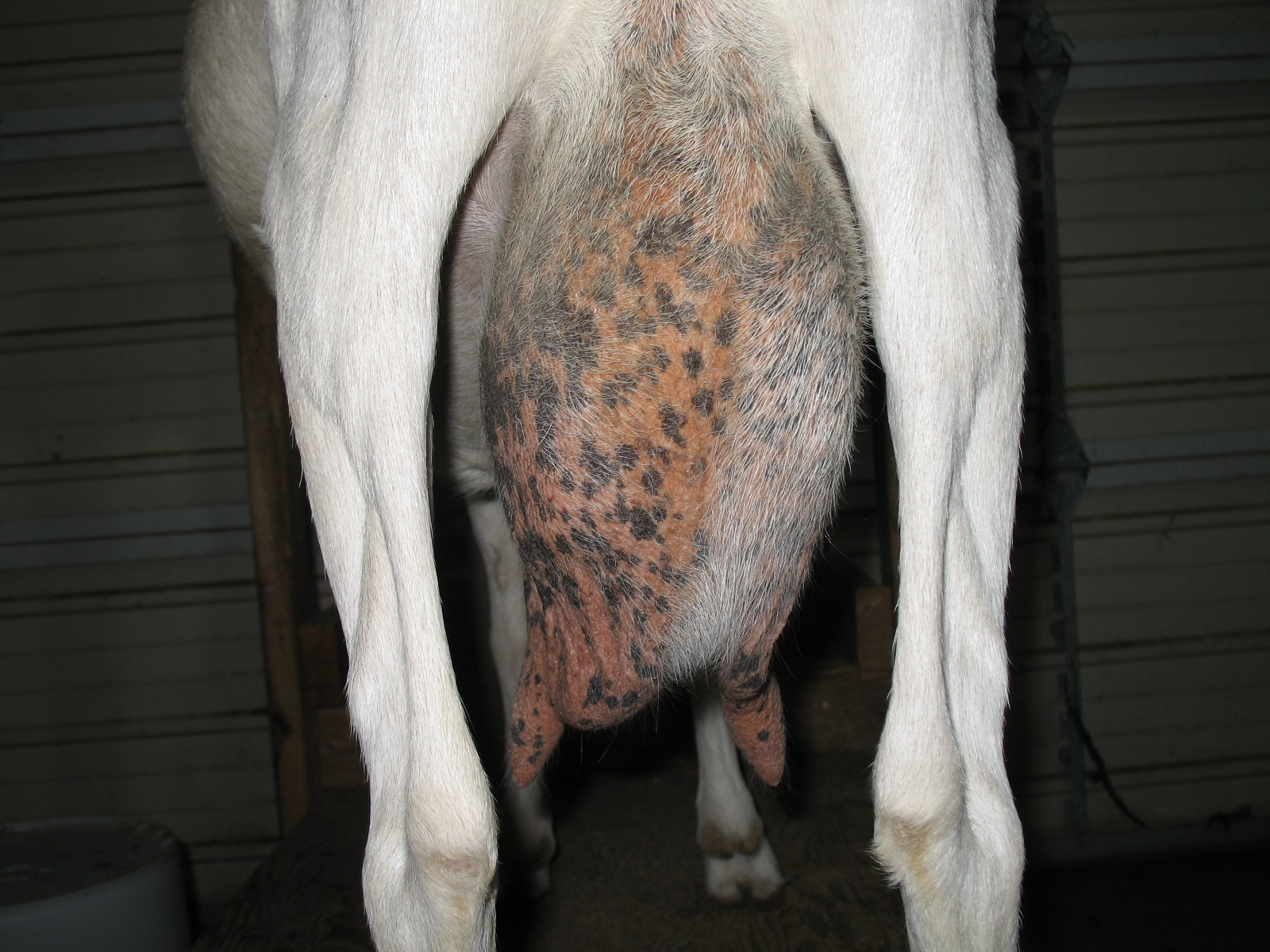
Winner of the "Ugliest Udder" Contest!
Well, not really. There isn't really any contest called the "Ugliest Udder" Contest.
But this gal would win if there was!
Her name is Gidget. She is a sweet goat. This is the fourth year she is here being bred to our buck. Surprisingly, she throws beautiful kids when bred to our buck! None of them have udders that look like this. They all have very good or excellent udders with good attachments. All of Gidget's grandkids that her owner has kept track of have had twins on the first birth. Gidget usually has triplet doelings, but last year she had 2 doelings and one buckling.
Gidget will never win any prizes at a goat show. But if her owners had the money to put her on milk test, she would probably get a good * rating with ADGA (she is a registered American Saanen). She is also a good girl on the milk stand. You can imagine that giving all this milk, she is also a grain vacuum.
Just a little history. Last year at this time she was only milking about 1 lb, sometimes 1.5 lbs. She was really copper deficient! This spring her owners gave her a liquid copper supplement that Hubby mixed up for our Saanens and she had more milk all summer.
We are lucky to have her most of the winter and enjoy all the milk. More milk means more cheese!
But this gal would win if there was!
Her name is Gidget. She is a sweet goat. This is the fourth year she is here being bred to our buck. Surprisingly, she throws beautiful kids when bred to our buck! None of them have udders that look like this. They all have very good or excellent udders with good attachments. All of Gidget's grandkids that her owner has kept track of have had twins on the first birth. Gidget usually has triplet doelings, but last year she had 2 doelings and one buckling.
| This sweet doe has a really bad side udder attachment. Her front and back attachment aren't great, either. Her udder looks like a bag that is just barely holding on! |
| After milking. Looks worse, poor thing! |
| To be fair to the gentle girl, this is a photo of her standing differently so her empty udder looks a little better. |
| This is the other reason her owners keep her! She milks out 7lbs - 8 lbs every night! When she is milking during the summer, she gives 7lbs - 8lbs every milking for a total of 14+ lbs per day. |
Just a little history. Last year at this time she was only milking about 1 lb, sometimes 1.5 lbs. She was really copper deficient! This spring her owners gave her a liquid copper supplement that Hubby mixed up for our Saanens and she had more milk all summer.
We are lucky to have her most of the winter and enjoy all the milk. More milk means more cheese!
Friday, September 17, 2010
The New Vet and Ginger's Udder
This is a really long post! It tries to describe what we've been trying to clear up for a year. I've kept pretty good notes, but as I look back, the notes probably could have been better.
We've had this problem with Ginger's udder for a long time. Here's a link to the original post.
We tried all sorts of different treatments trying to get rid of the problem. It got worse slowly over the last year.
We tried Fura-zone Ointment for a week... no change.
We tried Blu-Kote spray for a week... no change
We tried Colloidal Siver for a week... no change.
We tried Neosporin for a week... no change.
We even tried 7% Iodine for a week.... no change, except udder became really dry.
Some of the other things we have tried are Tinactin and RashBasher in case it was a fungal infection.
Two weeks ago we read an article from Onion Creek Ranch that indicated to clear up their staph infection they had to pull the scabs off to make the meds more effective. We started scraping scabs off while scrubbing with Hibiclens. We read that Scour Halt (spectinomycin) is effective against gram-positive and gram-negative organisms. This seemed to help slightly. But, what was going on with her udder never fit the description of a staph infection any more than it fit in with any of the other descriptions of other infections.
It couldn't be sore mouth, she never had sores on her mouth and it didn't spread through the herd. Also, sore mouth (Orf virus) usually clears up on it's own within two months.
It couldn't be sarcoptes mites because the Ivermectin would have cleared it up (we've used it twice over the past year.) And he said it didn't look like mites, either.
It didn't look anything like a fungal infection.
I can't remember the other things he said it just didn't look like. The list of things he came up with was the same as the list of things we had tried to cure, plus a few.
He said it looked like a mild bacterial infection and a severe allergic reaction to something in her environment. He asked if there was anything we had changed before the problem started like bedding. We hadn't. We have changed things over the past year, but not before this started. Since she has no other lesions anywhere on her body. Right now, because of the localized reaction, we are assuming that this is something to do with the udder wash, bedding, or something else we haven't figured out.
He said that he could run a biopsy and see if it was some sort of allergic reaction. It would be expensive ($185) and he understands that not everyone wants to spend that much on a goat. With everything we had tried and the records we had kept, he wasn't sure what it was. I said maybe I made it worse with everything I had tried. He said he really didn't think so, as long as this has been going on he thought there wasn't a treatment that I had done that would have made it worse. He would have tried many of the same things.
We told him to go ahead and do the biopsy. We really would like to learn more about whatever it is she is dealing with. The cost of the procedure, the farm call, and the Exenel antibiotic was more than what we paid for the goat. But.... we consider this this as 'tuition'.
What next? After the biopsy comes back we will probably end up putting her on some steroids (if it is an allergic reaction to something) and then try to figure out what she is allergic to. Right now the plan is to change nothing except to give her Exenel shots for the next 3 days for the slight bacterial infection and see if that makes any difference. Since the penicillin hadn't done anything, he wants to try Exenel and keep the rest of her life the same. He also said to discontinue the Scour Halt while we are using the Exenel so that we treating the bacterial infection with only one medication.
He said to not change anything else in her environment, feed, or anything else that we do with her. If her condition changes, he wants to be able to pinpoint where the change came from. If we change from Hibiclens to Chlorhexidine and noticed a change we wouldn't know if it was from the cleanser we were using or from the antibiotic. Hibiclens is 4% Chlorhexidine solution and is dyed pink, Chlorhexidine for animals is 2% and dyed blue. We are following his directions even though I would love to use the much less expensive Chlorhexidine.
The rest of the post shows photos of the biopsy procedure:
We've had this problem with Ginger's udder for a long time. Here's a link to the original post.
We tried all sorts of different treatments trying to get rid of the problem. It got worse slowly over the last year.
| What Ginger's udder looked like June 2009 |
Here's what we did at first:
We tried Fura-zone Ointment for a week... no change.
We tried Blu-Kote spray for a week... no change
We tried Colloidal Siver for a week... no change.
We tried Neosporin for a week... no change.
We even tried 7% Iodine for a week.... no change, except udder became really dry.
Some of the other things we have tried are Tinactin and RashBasher in case it was a fungal infection.
We also used Ivomec twice over the past year. Once because we like to use it as a wormer once a year, the other time was just in case the problem Ginger had happened to be mites.
We also tried Penicillin 5cc 2x for the first day, 4 cc each day for the next 4 days for a total of 5 days.... No change
About 2 months ago we decided to try Hibiclens 2x a day for 3 minutes or more each. Maybe this was some sort of surface bacterial infection or a staph infection.
We also tried Penicillin 5cc 2x for the first day, 4 cc each day for the next 4 days for a total of 5 days.... No change
About 2 months ago we decided to try Hibiclens 2x a day for 3 minutes or more each. Maybe this was some sort of surface bacterial infection or a staph infection.
During the same time we used Hibiclens we also used Silvasorb applied after milking. This seemed to help a little bit.
| This photo taken 6 September 2010 shows the scabs. None of the sores ever oozed puss . |
We ran out of Silvasorb and switched to RashBasher just in case it might be a fungal infection. Yes, we were grasping straws at this point. Still reading and searching to see what we could find about rashes on a goat's udder. The rash never spread past the outside of her udder on both sides. It never spread to the inside of her legs, never spread to her stomach or any other place on her body. It never spread to between her teats either, although it did get red and dry between her teats. It never spread to any of the other goats. It never completely fit with any description we read on the internet or in the vetting books we have at home. It never completely fit in with the descriptions or suggestions that we received from questions asked on some of the yahoo groups we are on.
Two weeks ago we read an article from Onion Creek Ranch that indicated to clear up their staph infection they had to pull the scabs off to make the meds more effective. We started scraping scabs off while scrubbing with Hibiclens. We read that Scour Halt (spectinomycin) is effective against gram-positive and gram-negative organisms. This seemed to help slightly. But, what was going on with her udder never fit the description of a staph infection any more than it fit in with any of the other descriptions of other infections.
| This photo was taken 5 days after pulling the scabs off while washing with the Hibiclens, after milking we applied Scour Halt topically. More improvement, the most we have seen. |
We finally found a vet who regularly treats goats and sheep. His practice is 90% horses, but he knows his goats and sheep, which is unusual around here. When he came out he was glad that we had record of what we had tried as well as a few photos of her udder. He went down the list of infections and diseases that might cause something like this, thinking out loud as he went through them.
It couldn't be sore mouth, she never had sores on her mouth and it didn't spread through the herd. Also, sore mouth (Orf virus) usually clears up on it's own within two months.
It couldn't be sarcoptes mites because the Ivermectin would have cleared it up (we've used it twice over the past year.) And he said it didn't look like mites, either.
It didn't look anything like a fungal infection.
I can't remember the other things he said it just didn't look like. The list of things he came up with was the same as the list of things we had tried to cure, plus a few.
He said it looked like a mild bacterial infection and a severe allergic reaction to something in her environment. He asked if there was anything we had changed before the problem started like bedding. We hadn't. We have changed things over the past year, but not before this started. Since she has no other lesions anywhere on her body. Right now, because of the localized reaction, we are assuming that this is something to do with the udder wash, bedding, or something else we haven't figured out.
He said that he could run a biopsy and see if it was some sort of allergic reaction. It would be expensive ($185) and he understands that not everyone wants to spend that much on a goat. With everything we had tried and the records we had kept, he wasn't sure what it was. I said maybe I made it worse with everything I had tried. He said he really didn't think so, as long as this has been going on he thought there wasn't a treatment that I had done that would have made it worse. He would have tried many of the same things.
We told him to go ahead and do the biopsy. We really would like to learn more about whatever it is she is dealing with. The cost of the procedure, the farm call, and the Exenel antibiotic was more than what we paid for the goat. But.... we consider this this as 'tuition'.
What next? After the biopsy comes back we will probably end up putting her on some steroids (if it is an allergic reaction to something) and then try to figure out what she is allergic to. Right now the plan is to change nothing except to give her Exenel shots for the next 3 days for the slight bacterial infection and see if that makes any difference. Since the penicillin hadn't done anything, he wants to try Exenel and keep the rest of her life the same. He also said to discontinue the Scour Halt while we are using the Exenel so that we treating the bacterial infection with only one medication.
He said to not change anything else in her environment, feed, or anything else that we do with her. If her condition changes, he wants to be able to pinpoint where the change came from. If we change from Hibiclens to Chlorhexidine and noticed a change we wouldn't know if it was from the cleanser we were using or from the antibiotic. Hibiclens is 4% Chlorhexidine solution and is dyed pink, Chlorhexidine for animals is 2% and dyed blue. We are following his directions even though I would love to use the much less expensive Chlorhexidine.
The rest of the post shows photos of the biopsy procedure:
| Everything the vet needs for the procedure is in his truck. He's thankful we have a place to put it all. |
| Vet2Be holding the bottle that contains a solution to preserve the tissue samples. |
| The three samples are in the lower part of the jar. |
The samples are at the Colorado State University lab by now. We milked Ginger last night without interfering with the stitches. We'll wait and see what the lab results are.
I was impressed with how much the vet knew about diseases of goats, about goats in general, and his 'barnside manner.'
Ginger is in good hands with this vet!
Tuesday, September 14, 2010
The Reason I Started Making Cheese
Thursday, September 2, 2010
Clabbered Milk: Part 5 (another try!)
So, another failure. This time it never separated (5 days) and when I looked inside, there was yellow mold growing on top.
I think my clabbered milk failures might have something to do with the temperature in our kitchen. It fluctuates quite a bit and it usually isn't warm.
I ordered the book, "Nourishing Traditions" by Sally Fallon. I've read about it a few places on the internet and one of my friends recently bought it. The book is supposed to have more instructions on how to make clabbered milk, or raw cream cheese as it's called in the book.
Another Try....
This time I turned the oven light on and left the door closed for an hour. Then I checked the temperature inside the oven. It was 81˚ F. One person I heard from via email or post said that her kitchen is always around 81˚ F or 82˚ F and hers separates quite quickly.
So, I have another 1/2 gallon of raw goat milk (milked on 8/24) sitting in the oven with the light on. I'll see how it turns out this time.
I didn't take another photo yet, because it looks just the same as it did earlier this afternoon. It's about 6:00 pm on 8/31/10, same day as the photo above. But I took the rag off the top (yes, that's one of my t-shirt rags!) and it smells..... good!
It smells a bit like yogurt, but not quite. It isn't really thick yet, like I've read so many places. It had a bit of a skin on top so I scooped it off and threw it away so the milk isn't sealed with the skin.
At this point I think that the oven with the light on is probably the best place in my kitchen to make clabbered milk. The temperature remains fairly constant and there is no yeast floating around in the air.
9/1/10 at 7:00 AM
I opened the oven door and the milk had separated! No bulging on the top, no weird smell! I can hardly believe it!
For my house, where the temperature fluctuates between 68˚- 80˚, clabbering the milk in the oven with the light on is probably the best place.
I put it in the oven on Sunday night and Wednesday morning I have some beautiful clabbered milk!
On India Curry, one of the sites I found, it said the optimum temperature for making clabbered milk is 90˚F. I also found some interesting information on Wikipedia. People in the Southern United States would eat it for breakfast with brown sugar, cinnamon, or molasses added. Smelling it while I am typing, I think that sounds delicious!
And as I was searching I came across a reference to 'Quark'. Another type of cream cheese that is made by letting milk sit overnight. Put that on my to do list!
One thing that has really surprised me while I have been learning to make cheese is how often we leave the curds at room temperature, or drain at room temperature. If someone had told me last year that I would have been leaving raw milk out for 4 days and then eating the result, I would have told them they were crazy! I can hear my mom and grandma saying, "Put the milk away before it spoils!"
After a little more searching, I found out that letting the milk get to this point is called 'clotted cream'. Here's the Wise Geek link where I found it.
Everything Goat Milk". This link takes you directly to their cheesemaking page.
Now I am scouring the internet to find different recipes using clabbered milk and clotted cream! I imagine I'll have to find some cookbooks from the early 1800's to browse through.
So much milk, so little time in a day!
I think my clabbered milk failures might have something to do with the temperature in our kitchen. It fluctuates quite a bit and it usually isn't warm.
I ordered the book, "Nourishing Traditions" by Sally Fallon. I've read about it a few places on the internet and one of my friends recently bought it. The book is supposed to have more instructions on how to make clabbered milk, or raw cream cheese as it's called in the book.
Another Try....
This time I turned the oven light on and left the door closed for an hour. Then I checked the temperature inside the oven. It was 81˚ F. One person I heard from via email or post said that her kitchen is always around 81˚ F or 82˚ F and hers separates quite quickly.
So, I have another 1/2 gallon of raw goat milk (milked on 8/24) sitting in the oven with the light on. I'll see how it turns out this time.
| 8/30/10 at 8:30 AM, still looks the same, no change. |
| And another photo on 8/31/10 at 2:00 PM. Hmmmmm..... still looks the same. Linda said that she likes hers when a thin liquid is between the clabbered milk and the jar. |
It smells a bit like yogurt, but not quite. It isn't really thick yet, like I've read so many places. It had a bit of a skin on top so I scooped it off and threw it away so the milk isn't sealed with the skin.
At this point I think that the oven with the light on is probably the best place in my kitchen to make clabbered milk. The temperature remains fairly constant and there is no yeast floating around in the air.
9/1/10 at 7:00 AM
| Whoo Hoo!! It looks like it worked! |
For my house, where the temperature fluctuates between 68˚- 80˚, clabbering the milk in the oven with the light on is probably the best place.
I put it in the oven on Sunday night and Wednesday morning I have some beautiful clabbered milk!
| This is what it looks like after I took the cloth off the top. It looks and smells delicious. This time it looks creamy, not hard, like the last few times. |
| Hanging from my cider press by my desk. I can smell it from here. It smells a little sweet and a little sour at the same time. More a yogurt-type sour instead of a lemon-type sour. |
On India Curry, one of the sites I found, it said the optimum temperature for making clabbered milk is 90˚F. I also found some interesting information on Wikipedia. People in the Southern United States would eat it for breakfast with brown sugar, cinnamon, or molasses added. Smelling it while I am typing, I think that sounds delicious!
And as I was searching I came across a reference to 'Quark'. Another type of cream cheese that is made by letting milk sit overnight. Put that on my to do list!
One thing that has really surprised me while I have been learning to make cheese is how often we leave the curds at room temperature, or drain at room temperature. If someone had told me last year that I would have been leaving raw milk out for 4 days and then eating the result, I would have told them they were crazy! I can hear my mom and grandma saying, "Put the milk away before it spoils!"
After a little more searching, I found out that letting the milk get to this point is called 'clotted cream'. Here's the Wise Geek link where I found it.
| After draining for 3 hours it is creamy and smooth. It looks a bit lumpy in the photo, but a taste in my mouth proves it is rich and buttery. It looks like it made about 1/2 pound of clabbered milk. |
Now I am scouring the internet to find different recipes using clabbered milk and clotted cream! I imagine I'll have to find some cookbooks from the early 1800's to browse through.
So much milk, so little time in a day!
Tuesday, August 24, 2010
Clabbered Milk: Part 4 (failed again!)
Another batch gone bad. It looks like yeast again.
When I checked the bottle the second day the milk seemed to be getting thicker. Today when I checked, it was growing out of the top of the bottle.
I think I'll try keeping it in another part of the kitchen to see if it makes a difference.
I think the nice thing about having 3-4 gallons of milk a day is that I get to try so many things. If something fails I try to figure out what went wrong and try it another way.
| Can you see the cloth on top all poofed up? That's because something is growing out of the top of the bottle. |
| It separated, and it grew. I think it grew yeast again. This time it grew faster than the last time. |
I think I'll try keeping it in another part of the kitchen to see if it makes a difference.
I think the nice thing about having 3-4 gallons of milk a day is that I get to try so many things. If something fails I try to figure out what went wrong and try it another way.
Friday, August 20, 2010
Clabbered Milk: Part 3 (and more to come...)
Hmmm... I checked the clabbered milk this morning. I stirred it up a bit and it was foamy under the cream. I think that means it was contaminated by yeast.
It still doesn't smell bad which is not what I expected from leaving raw milk on the counter for almost 5 days!
I dumped it down the drain, just to be on the safe side. I 'started' a new batch with the warm milk that we brought in from the barn this morning.
Hopefully this time it will work.
If it does, I'll look around for a great looking stoneware crock for the milk to clabber in!
It still doesn't smell bad which is not what I expected from leaving raw milk on the counter for almost 5 days!
I dumped it down the drain, just to be on the safe side. I 'started' a new batch with the warm milk that we brought in from the barn this morning.
Hopefully this time it will work.
If it does, I'll look around for a great looking stoneware crock for the milk to clabber in!
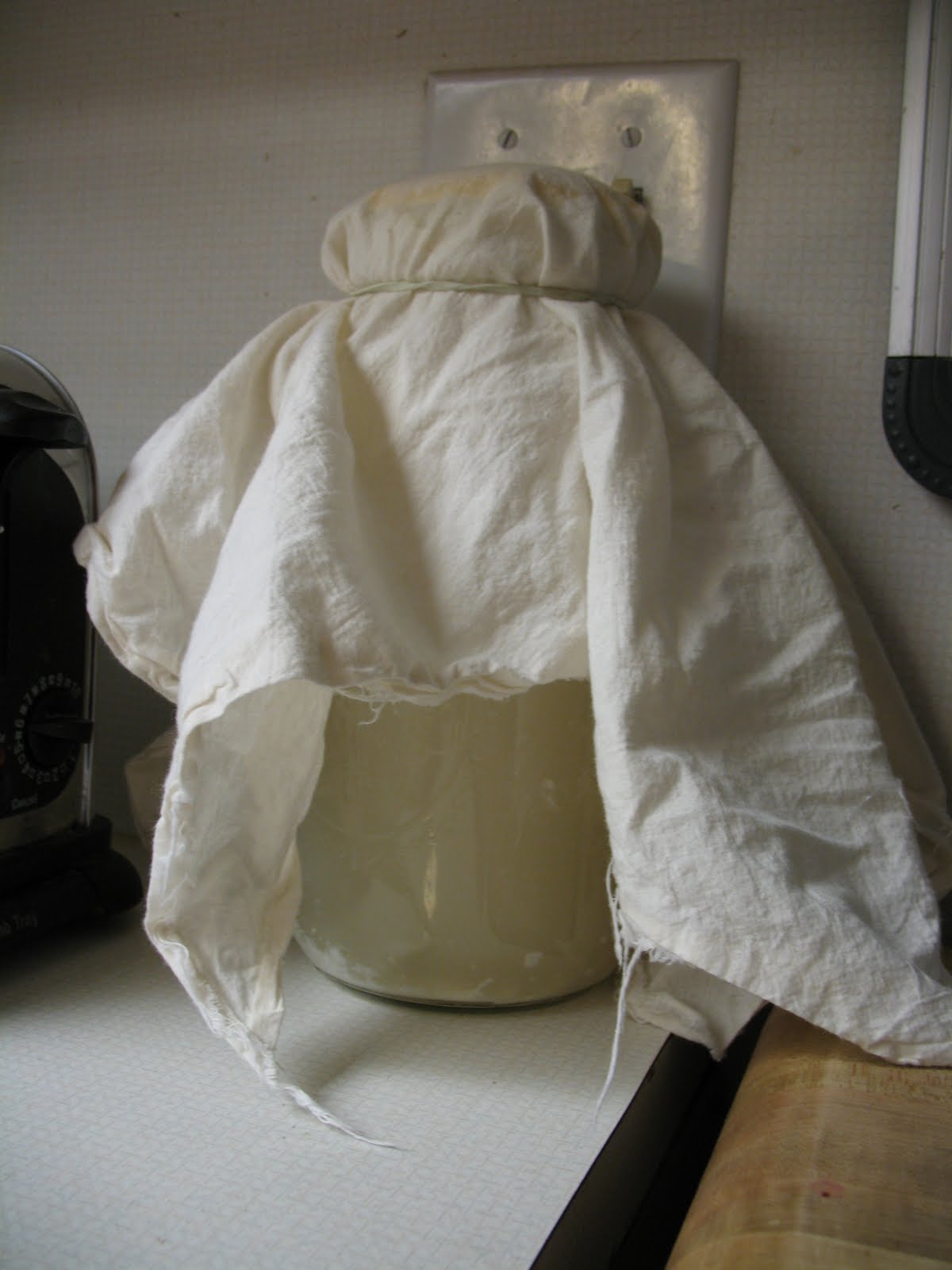
Fresh milk, new jar, and a new cloth with a rubber band around the lid.
Tuesday, August 17, 2010
Clabbered Milk: Part 2
I've been doing some more reading about clabbered milk. Some places on the internet say to leave it in a sealed container, but more of the sites I have come across said to leave it in a loosely covered container, preferably the opening should be covered with a cloth.
When I checked the milk on the counter Tuesday morning, there was really no change except that the cream had separated to the top.
So I stirred the cream in a bit, changed the stickers to the side of the container, and covered it with a cloth.
I must say, I am really surprised that there was no nasty smell coming from the milk when I checked it! There was nothing gross about it at all. It still smelled like milk! Surprise!
When I checked the milk on the counter Tuesday morning, there was really no change except that the cream had separated to the top.
So I stirred the cream in a bit, changed the stickers to the side of the container, and covered it with a cloth.
I must say, I am really surprised that there was no nasty smell coming from the milk when I checked it! There was nothing gross about it at all. It still smelled like milk! Surprise!
I've lifted the cloth so you can see all our crazy labels. But I've had the cloth down over the whole container since I put it on. It's been sitting on the counter since 11/15/10 but the milk was milked out on 8/11/10 in the evening. It had been sitting in the fridge until I put it on the counter.
I've emailed a few friends, and they are interested in the clabbered milk, too! If they find any recipes I'll be sure to post them here. I'm really curious about this and what can be done with it.
Tomorrow we are at the 4H goat show, but I wanted to update this little experiment because I don't want to forget what I've done and how long it took when I try to reproduce it (or not) later on.
And just in case there is anyone else out there who is trying this and following along, too!
Sunday, August 15, 2010
Clabbered Milk
l had a question from someone a few weeks ago. She was told to leave her raw milk on the counter for 3-5 days and it would turn into cream cheese. Leaving raw milk on the counter sounded really gross to me, not to mention that it seemed like the resulting product might be unsafe.
I did some reading and asked some questions. Apparently it is called clabbered milk and used to be made often. It can only be done with raw milk, not pasteurized milk, because the pasteurization kills some of the bacteria that is needed to clabber the milk.
On a side note--that's why Clabber Girl baking powder was originally made. You would add the baking powder to clabbered or loppered milk to produce a leavening reaction.
Here is a link on how to make clabbered milk:
The Nourishing Cook
Someone on the Basic Cheesemaking Yahoo Group said they do this all the time. She freezes the results and it makes a 'killer cheese cake' during the winter.
I've got lots of raw goat milk in the fridge right now. I think I'm going to give this a try.
I did some reading and asked some questions. Apparently it is called clabbered milk and used to be made often. It can only be done with raw milk, not pasteurized milk, because the pasteurization kills some of the bacteria that is needed to clabber the milk.
On a side note--that's why Clabber Girl baking powder was originally made. You would add the baking powder to clabbered or loppered milk to produce a leavening reaction.
Here is a link on how to make clabbered milk:
The Nourishing Cook
Someone on the Basic Cheesemaking Yahoo Group said they do this all the time. She freezes the results and it makes a 'killer cheese cake' during the winter.
I've got lots of raw goat milk in the fridge right now. I think I'm going to give this a try.
Sitting on the counter waiting.... and waiting....
Update: I just recieved this link from a friend. It has some great information and recipes for clabbered milk! NH Honey.
Saturday, November 21, 2009
The Experiment
I wanted to see just how well Hubby's sanitizing solution worked on the does' udders so we did an experiment last week.
I washed the does' udders in the sanitizing solution, all of them with the same solution using the same paper towel. Then I took the water into the house and Vet2Be put 1ml on a petri dish and set it in the incubator (not for chicks, Hubby is a chemist, we happen to have an incubator for incubating other experiments :).
Vet2Be incubated the sample for 3 days.
I washed the does' udders in the sanitizing solution, all of them with the same solution using the same paper towel. Then I took the water into the house and Vet2Be put 1ml on a petri dish and set it in the incubator (not for chicks, Hubby is a chemist, we happen to have an incubator for incubating other experiments :).
The yucky water after we washed the does udders with it.
Vet2Be incubated the sample for 3 days.
The incubator.
The sample Vet2Be put in the incubator. I should have taken the lid off because all you see right now is the condensation.
Nothing grew! That means that when we wash the does udders we kill all the bacteria and viruses that are present!
Clean udders are one of the steps in clean, great tasting milk!
Tuesday, August 18, 2009
Matitis Vaccinations
Vet2Be gave Glacier her second set of mastitis vaccinations the morning of August 12. She was a bit sore that night, but other than that, she seems fine. We'll see how she does with the mastitis through the rest of the fall and next spring since she has freshened with mastitis the last two year.
We used both the J-Vac and the Lysignin vaccinations that are for heifers. We used half the dose used for the heifers since the dairy goats are probably less than half the size of heifers. Vet2Be used a different needle for each injection and put each injection into a different area.
Thursday, August 13, 2009
Udder Rash
Ginger, Vet2Be's favorite goat, has had a rash on her udder for more than two months. It hasn't gotten worse, and it hasn't gotten better. None of the other goats have it.
We tried Fura-zone Ointment for a week... no change.
We tried Blu-Kote spray for a week... no change (except she had a blue udder for a week!)
We tried Colloidal Siver for a week... still no change.
We tried Neosporin for a week... yup, no change.
We even tried 7% Iodine for a week.... nothing.
Our next course of action will be mastitis vaccinations. She doesn't have any symptoms of mastitis, but the J-Vac is a vaccination information says it is effective against E. coli mastitis, and the Lysigin is said to be effective against Staph aureus. So, maybe Ginger has something on the inside that is manifesting itself on the outside of her udder.
We tried Fura-zone Ointment for a week... no change.
We tried Blu-Kote spray for a week... no change (except she had a blue udder for a week!)
We tried Colloidal Siver for a week... still no change.
We tried Neosporin for a week... yup, no change.
We even tried 7% Iodine for a week.... nothing.
Our next course of action will be mastitis vaccinations. She doesn't have any symptoms of mastitis, but the J-Vac is a vaccination information says it is effective against E. coli mastitis, and the Lysigin is said to be effective against Staph aureus. So, maybe Ginger has something on the inside that is manifesting itself on the outside of her udder.
Saturday, August 1, 2009
Udder Rash
Ginger, Vet2Be's favorite goat, has had a rash on her udder for more than two months. It hasn't gotten worse, and it hasn't gotten better. None of the other goats have it.
We tried Fura-zone Ointment for a week... no change.
We tried Blu-Kote spray for a week... no change (except she had a blue udder for a week!)
We tried Colloidal Siver for a week... still no change.
We tried Neosporin for a week... yup, no change.
We even tried 7% Iodine for a week.... nothing.
Our next course of action will be mastitis vaccinations. She doesn't have any symptoms of mastitis, but the J-Vac is a vaccination supposed to be effective against E. coli mastitis, and the Lysigin is supposed to be effective against Staph aureus. So, maybe she has something on the inside that is manifesting itself on the outside of her udder.
We tried Fura-zone Ointment for a week... no change.
We tried Blu-Kote spray for a week... no change (except she had a blue udder for a week!)
We tried Colloidal Siver for a week... still no change.
We tried Neosporin for a week... yup, no change.
We even tried 7% Iodine for a week.... nothing.
Our next course of action will be mastitis vaccinations. She doesn't have any symptoms of mastitis, but the J-Vac is a vaccination supposed to be effective against E. coli mastitis, and the Lysigin is supposed to be effective against Staph aureus. So, maybe she has something on the inside that is manifesting itself on the outside of her udder.
Friday, June 5, 2009
More Treatments
This morning I decided to treat Glacier with "Today", an intra-mammary infusion to kill mastitis-causing organisms. Since she didn't get better with the Penicillin or the Albon, we need to try a different drug. Last night there were so many clumps in her milk that I could hardly believe it. It is odd because the teat that is infected is giving the most milk, almost twice as much as the other teat. Her milk production hasn't decreased, either. She is still giving 5.5-6 lbs at each milking (about 3/4 gallon). She has no fever, is eating well and doesn't seem to be affected by it. Her milk all gets fed to the chickens and the ducks since we can't drink it.
The chickens and the ducks are doing very well on the milk. I dropped a chicken egg the other day and it didn't even crack on the hard ground. The 9 year old Ameraucana is also laying again.
I found a clutch of duck eggs this morning, too. I think there are at least a dozen in the nest. One of the ducks is sitting on them. I'll leave everything alone and see if she can hatch some out. I'm sure we can find homes for them without trouble. People seem to love the ducks.
I gave one of our neighbors (with 7 children) 2 dozen duck eggs a few days ago. The are a wonderful family and the children are so much fun to be around. They stopped by yesterday and told me that, "Duck eggs are 5000 times better than chicken eggs!" They are so happy that they bought ducklings this year and can't wait until they start laying in a few months.
Since Glacier still has mastitis, Buddy is still not moving much, and Clover is acting 'weird' I decided to give worm those three with Ivomec Plus at 1 cc/ 100 pounds. I gave Clover and Glacier 2 cc each and Buddy got .5 cc, all SQ. In ten days I'll do it all again. I found a paper written by Jim Miller at Louisianna State University on parasites and treatment. Vet2Be'assignment will be to read the paper when he comes home from his canoe trip. It has extra-label dosages and milk withdrawl times for a number of different wormers as well as other information on worming and identifying worms.
The chickens and the ducks are doing very well on the milk. I dropped a chicken egg the other day and it didn't even crack on the hard ground. The 9 year old Ameraucana is also laying again.
I found a clutch of duck eggs this morning, too. I think there are at least a dozen in the nest. One of the ducks is sitting on them. I'll leave everything alone and see if she can hatch some out. I'm sure we can find homes for them without trouble. People seem to love the ducks.
I gave one of our neighbors (with 7 children) 2 dozen duck eggs a few days ago. The are a wonderful family and the children are so much fun to be around. They stopped by yesterday and told me that, "Duck eggs are 5000 times better than chicken eggs!" They are so happy that they bought ducklings this year and can't wait until they start laying in a few months.
Since Glacier still has mastitis, Buddy is still not moving much, and Clover is acting 'weird' I decided to give worm those three with Ivomec Plus at 1 cc/ 100 pounds. I gave Clover and Glacier 2 cc each and Buddy got .5 cc, all SQ. In ten days I'll do it all again. I found a paper written by Jim Miller at Louisianna State University on parasites and treatment. Vet2Be'assignment will be to read the paper when he comes home from his canoe trip. It has extra-label dosages and milk withdrawl times for a number of different wormers as well as other information on worming and identifying worms.
Wednesday, May 27, 2009
Buddy Update and Janice's milk production
Buddy is doing better. I almost can't believe it. He is up and walking, eating hay and grazing on the pasture. He is drinking milk and some water.
He had 5 days of Albon. Our new order arrived yesterday but we decided to give his body a break from antibiotics for 48 hours to see how he does.
We also weighed him last night. He weighs 32 pounds. He has gained weight through his illness and that is wonderful!
Also, whatever has happened to Janice through this last pregnancy and kidding season has been a wonderful blessing. This is Vet2B's fancy 6* milking doe that didn't seem to ever produce much milk. Yesterday morning she gave 8 pounds, 7 ounces. Last night she gave 8 pounds 11 ounces. She has small teats that are nearly impossible to milk when she is producing that much milk, so we use the milker at every milking. Last year we were lucky to get 4 pounds from her at any milking.
The things that changed this year are that Janice had twin bucklings, she lost weight before the pregnancy, is grazing very well after the pregnancy, and is taking a multi-vitamin and vitamin C every day. She looks very good. I think she is about 7 years old, but you wouldn't know it by looking at her on the outside.
Janice was raised at a dairy and then spent some time at a friend's home before she came to us. The friend taught her how to get milked by hand and how to be around people. We finished the job here. Because she was at the dairy and then at our friend's home, she had never grazed before. She had to learn that last summer at our place. This will be her second summer with us and it looks like she is doing very well.
Tuesday (May 25) was the first day all the kids (except Buddy) were in the dry lot away from their moms. They yelled most of the day, of course. But they are eating and drinking and doing fine. Someone is coming to pick up one of Janice's bucklings today, and someone else is coming this week to pick up Gingers doelings.
He had 5 days of Albon. Our new order arrived yesterday but we decided to give his body a break from antibiotics for 48 hours to see how he does.
We also weighed him last night. He weighs 32 pounds. He has gained weight through his illness and that is wonderful!
Also, whatever has happened to Janice through this last pregnancy and kidding season has been a wonderful blessing. This is Vet2B's fancy 6* milking doe that didn't seem to ever produce much milk. Yesterday morning she gave 8 pounds, 7 ounces. Last night she gave 8 pounds 11 ounces. She has small teats that are nearly impossible to milk when she is producing that much milk, so we use the milker at every milking. Last year we were lucky to get 4 pounds from her at any milking.
The things that changed this year are that Janice had twin bucklings, she lost weight before the pregnancy, is grazing very well after the pregnancy, and is taking a multi-vitamin and vitamin C every day. She looks very good. I think she is about 7 years old, but you wouldn't know it by looking at her on the outside.
Janice was raised at a dairy and then spent some time at a friend's home before she came to us. The friend taught her how to get milked by hand and how to be around people. We finished the job here. Because she was at the dairy and then at our friend's home, she had never grazed before. She had to learn that last summer at our place. This will be her second summer with us and it looks like she is doing very well.
Tuesday (May 25) was the first day all the kids (except Buddy) were in the dry lot away from their moms. They yelled most of the day, of course. But they are eating and drinking and doing fine. Someone is coming to pick up one of Janice's bucklings today, and someone else is coming this week to pick up Gingers doelings.
Friday, May 22, 2009
Mastitis by Noah L. Goddard
This is a post that was on Managing Dairy Goats (yahoo group). Since we have had such a battle with Glacier and mastitis again this year (although not as badly as last year) it seemed like a good idea to post this for future reference.
Mastitis Vaccines
Mastitis Resistance: J-5 & Lysigin Vaccines
With kidding under way does are really stressed during this brutal winter weather and subject to acute mastitis at, or shortly after, freshening. If you have not already done so please consider vaccinating vulnerable does against Staph aureus and E. coli mastitis.
Fresh does always seem to be the most vulnerable to mastitis outbreaks. First, I want to emphasize that I am not a Veterinarian and that I make no claims of medical training nor am I recommending any treatments, therapies, or preventives. We use two cattle vaccines off label pursuant to the direction of our veterinarian, J-5 as an aid in the prevention of clinical mastitis caused by E.coli and Lysigin as an immunization against disease caused by staphylococcus aureus. While I am sure that these vaccines are sold by other vendors, both of these are shown about mid-page 43 of the PBS Animal Health Catalog or you can find them on-line at www.pbsanimalhealth.com or call them at 1-800-321-0235. They can be purchased without a veterinary prescription.
We follow the package insert instructions for dosage of each vaccine IM using a smaller needle, 3/4 inch by 22 gauge. We start about midway in their pregnancy and repeat it for a total of three times and then give a fourth injection about two weeks after kidding. We then give a booster about midway through their lactation. We do not give both vaccines in the same leg and do not give the vaccines at the same time. We rotate and give the J-5 one week and the Lysigin the following week. You may get an occasional injection site reaction resulting is a sore leg but that can be easily managed with Banamine. We also vaccinate dry yearlings before they are bred to freshen as 2-year-olds. Does that are historically more susceptible to mastitis are given more frequent boosters to heighten their level of immunity. You may want to consult your veterinarian about frequency of boosters.
We also emphasize overall resistance to mastitis which includes milk room sanitation. The worst germ carriers are on the end of our arms and they are called hands. One of the most crucial mastitis preventives is a hand sink and antibacterial soap in your milk room. I can't emphasize enough the need for frequent hand washing. Washing hands with antibacterial soap before milking is important.
We use Nolvasan and individual washcloths for each doe to prep them before connecting them to the milking machine. We use an Iodine based post dip called Astro Tek which is kind of like pudding. It clogs the orifice and keeps dirt and debris carrying bacteria from entering the udder when they go out and lay down directly after milking. A bacteria-free milking machine is crucial to mastitis resistance. We use Mitricin Plus and hot water to clean our machine, then use a solution of Clorox and hot water after milking. Before the next milking we run another solution of clorox and hot water through the system and then rinse the system with plain hot water.
While other herd management practices may vary, we do not bed our loafing barn with hay, straw, shavings, or similar materials. It is well insulated and well ventilated. We use a 12-inch thick layer of lime screenings in the loafing barn which we believe keeps down bacteria that causes mastitis. We clean off the top layer periodically as needed and replace it with fresh screenings. Our loafing barn has a 22 foot by 60 foot awning on the south side that is used to cover the hay feeders. The hay feeders are 2x12 skids so they can be moved with the tractor permitting us to clean under the awning which is also bedded with 12 inches of lime screenings. The area under the awning requires more frequent cleaning as the goats spend much of their time in this area (see loafing area at http://www.goddardfarm.com/aboutus.htm). This loafing area also has a thermostat-controlled automatic Brower water system so the does have access to a fresh drink during all weather conditions (see attached picture). Fresh clean drinking water is crucial to herd health.
In all cases, we strongly recommend against beginning any new therapies, treatments, or vaccines without first consulting your regular veterinarian. The manufacturers package insert instructions, and/or those of your veterinarian should be followed and not deviated from.
Good Luck with your Mastitis Resistance program.
Noah
she now has clumps of blood coming out in her milk
what do I treat her with?
she weighs 120 lbs.
thanks Misty
You have a serious case of mastitis. First, get some milk samples of both sides of the udder and take them to your vet for cultures. Concomitantly start antibiotics immediately as follows, 8 to 10cc of Penicillin S.Q. twice a day for a total of 20cc per day for the first day. Then 6cc of Penicillin S.Q. twice a day for a total of 12cc each day for the next four days. Along with the Penicillin, give 5cc of Naxcel S.Q. daily for the same five days. Give 3cc of fortified B-complex daily for the same five days.
You need to vaccinate this doe and every animal in your herd with J-5 and Lysigin ASAP. Get into our list archive and read previous discussions on these vaccines.
Noah
Mastitis Vaccines
Mastitis Resistance: J-5 & Lysigin Vaccines
With kidding under way does are really stressed during this brutal winter weather and subject to acute mastitis at, or shortly after, freshening. If you have not already done so please consider vaccinating vulnerable does against Staph aureus and E. coli mastitis.
Fresh does always seem to be the most vulnerable to mastitis outbreaks. First, I want to emphasize that I am not a Veterinarian and that I make no claims of medical training nor am I recommending any treatments, therapies, or preventives. We use two cattle vaccines off label pursuant to the direction of our veterinarian, J-5 as an aid in the prevention of clinical mastitis caused by E.coli and Lysigin as an immunization against disease caused by staphylococcus aureus. While I am sure that these vaccines are sold by other vendors, both of these are shown about mid-page 43 of the PBS Animal Health Catalog or you can find them on-line at www.pbsanimalhealth.com or call them at 1-800-321-0235. They can be purchased without a veterinary prescription.
We follow the package insert instructions for dosage of each vaccine IM using a smaller needle, 3/4 inch by 22 gauge. We start about midway in their pregnancy and repeat it for a total of three times and then give a fourth injection about two weeks after kidding. We then give a booster about midway through their lactation. We do not give both vaccines in the same leg and do not give the vaccines at the same time. We rotate and give the J-5 one week and the Lysigin the following week. You may get an occasional injection site reaction resulting is a sore leg but that can be easily managed with Banamine. We also vaccinate dry yearlings before they are bred to freshen as 2-year-olds. Does that are historically more susceptible to mastitis are given more frequent boosters to heighten their level of immunity. You may want to consult your veterinarian about frequency of boosters.
We also emphasize overall resistance to mastitis which includes milk room sanitation. The worst germ carriers are on the end of our arms and they are called hands. One of the most crucial mastitis preventives is a hand sink and antibacterial soap in your milk room. I can't emphasize enough the need for frequent hand washing. Washing hands with antibacterial soap before milking is important.
We use Nolvasan and individual washcloths for each doe to prep them before connecting them to the milking machine. We use an Iodine based post dip called Astro Tek which is kind of like pudding. It clogs the orifice and keeps dirt and debris carrying bacteria from entering the udder when they go out and lay down directly after milking. A bacteria-free milking machine is crucial to mastitis resistance. We use Mitricin Plus and hot water to clean our machine, then use a solution of Clorox and hot water after milking. Before the next milking we run another solution of clorox and hot water through the system and then rinse the system with plain hot water.
While other herd management practices may vary, we do not bed our loafing barn with hay, straw, shavings, or similar materials. It is well insulated and well ventilated. We use a 12-inch thick layer of lime screenings in the loafing barn which we believe keeps down bacteria that causes mastitis. We clean off the top layer periodically as needed and replace it with fresh screenings. Our loafing barn has a 22 foot by 60 foot awning on the south side that is used to cover the hay feeders. The hay feeders are 2x12 skids so they can be moved with the tractor permitting us to clean under the awning which is also bedded with 12 inches of lime screenings. The area under the awning requires more frequent cleaning as the goats spend much of their time in this area (see loafing area at http://www.goddardfarm.com/aboutus.htm). This loafing area also has a thermostat-controlled automatic Brower water system so the does have access to a fresh drink during all weather conditions (see attached picture). Fresh clean drinking water is crucial to herd health.
In all cases, we strongly recommend against beginning any new therapies, treatments, or vaccines without first consulting your regular veterinarian. The manufacturers package insert instructions, and/or those of your veterinarian should be followed and not deviated from.
Good Luck with your Mastitis Resistance program.
Noah
***********************
I have an Alpine doe, kidded on March 25th,she now has clumps of blood coming out in her milk
what do I treat her with?
she weighs 120 lbs.
thanks Misty
***********************
Misty,You have a serious case of mastitis. First, get some milk samples of both sides of the udder and take them to your vet for cultures. Concomitantly start antibiotics immediately as follows, 8 to 10cc of Penicillin S.Q. twice a day for a total of 20cc per day for the first day. Then 6cc of Penicillin S.Q. twice a day for a total of 12cc each day for the next four days. Along with the Penicillin, give 5cc of Naxcel S.Q. daily for the same five days. Give 3cc of fortified B-complex daily for the same five days.
You need to vaccinate this doe and every animal in your herd with J-5 and Lysigin ASAP. Get into our list archive and read previous discussions on these vaccines.
Noah
Tuesday, May 19, 2009
Cajeta
Cajeta is a wonderful Mexican sweet sauce. It is a delicious concoction of goat milk, sugar, cinnamon, and vanilla. So smooth and sweet I want to eat it by the spoonful! (But I don't :o) It is traditionally made with goat milk, although you can use cow milk. I'm not sure how the cow milk will taste since we have only made it with goat milk. As we often do, we use what we have from our farm.
Since Vet2Be's big brother is on a mission in Mexico on a mission right now, Vet2Be likes to try different things from Mexico. Of course we would try Cajeta because it is traditionally made with goat milk!
Here is the recipe I use:
Ingredients
• 2 quarts of fresh goat's milk
• 2 cups white sugar (although we have also used 1 cup honey and 1 cup sugar)
• 1 cinnamon stick (or 1/2 teaspoon of cinnamon mixed with the sugar)
• 1 stick vanilla or 1 teaspoon of Mexican vanilla
• 1 teaspoon of baking soda
Directions


On the left is the amount of milk I started with, on the right is the amount of Cajeta the recipe makes.
Two quarts of goat's milk makes a little more than a pint of Cajeta. This batch took me almost 2 hours to make from start to finish.
Serve Cajeta over ice cream, on toast, as an apple dip, or anything you would use caramel sauce for. Yum!
Since Vet2Be's big brother is on a mission in Mexico on a mission right now, Vet2Be likes to try different things from Mexico. Of course we would try Cajeta because it is traditionally made with goat milk!
Here is the recipe I use:
Ingredients
• 2 quarts of fresh goat's milk
• 2 cups white sugar (although we have also used 1 cup honey and 1 cup sugar)
• 1 cinnamon stick (or 1/2 teaspoon of cinnamon mixed with the sugar)
• 1 stick vanilla or 1 teaspoon of Mexican vanilla
• 1 teaspoon of baking soda
Directions
- Stir together the milk and sugar in a heavy pot. The Cajeta will foam at one point, so make sure the pot holds at least twice as much as the recipe calls for. Add the cinnamon stick and the vanilla bean. Bring mixture to a gentle boil on medium heat while stirring constantly. Be careful not to scorch the milk. This may take 15 minutes.
- Remove from heat when the milk just starts to boil. Add the baking soda. The mixture will bubble and get foamy, keep stirring! When it stops foaming, you can put it back on the heat. It may foam a bit more, just be careful that it doesn't overflow the pot.
- Simmer the mixture just under a boil until it starts to turn golden brown and thicken. This will probably take another 45 minutes to an hour. Keep stirring! If you need to leave for a moment, turn the heat down (or remove the pot from the heat source) until you get back so you don't scorch the mixture.
- When the milk mixture starts to turn a golden brown, remove the cinnamon stick. (If you used a vanilla bean, take that out now, too) Watch it very closely because it will start to thicken quickly and has a tendency to scorch.
- Keep stirring (your arm should be tired by now unless you've had your kids helping to stir!) When the cajeta is a rich brown and thick enough to coat the back of a spoon it is ready. Add the vanilla. Cook until it reaches softball stage, about 230 F- 240 F (at sea level).
- Pour into a glass jar and cool. When it is cool enough, store it in the refrigerator.
Serve Cajeta over ice cream, on toast, as an apple dip, or anything you would use caramel sauce for. Yum!
Subscribe to:
Posts (Atom)