Showing posts with label kidding. Show all posts

Friday, April 7, 2017

New Kids 2017

Welcome back!

I know there are quite a few people enjoying Spring Break right now. I hope you are having a wonderful time while you're on vacation.

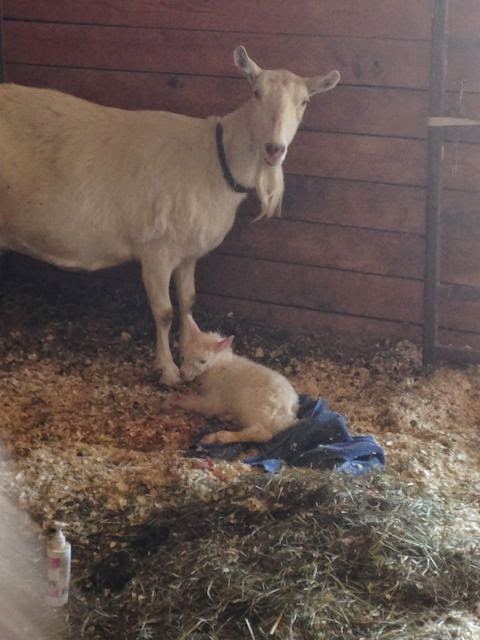
We've been busy and so have our mama goats! We have 6 new goat kids. Serenity and River kidded at the same time. They both kidded on Monday evening.

We had a big surprise because Serenity had 3 kids. We've never had a first freshener have 3 kids. They usually have one or two. Smaller breed goats have more, but the big breeds don't always have a lot of babies in one litter.

We dry off all the kids and put sweaters on them so they stay warm.
This is Serenity and her 3 kids.
She had two bucklings and one doeling.

Serenity looks so happy to have her kids close by her!
We keep the kids and mamas in a stall for about 2 days so the little kids don't get lost. They can walk, but they can't walk very well or very far, so it's best for them to stay in a small area with their mamas.


We let the kids out when they start playing inside the stall. That's when we know they are strong enough to find their mama when they need food. 

Misty had one kid on Tuesday night.
It was a rough birth because the kid was stuck.
She had one hoof forward, and one hoof back.
I had to pull her out!
We aren't sure why Misty doesn't have much milk this time. We are bottle feeding the baby. Misty is such a good mama that she taught her kid how to nurse anyway.

I thought you might like to see what it looks like when a goat has a baby. This is Serenity having her second kid.


The baby is fine, I had to turn off the camera and clean him off. He's running around with all the other babies.

Annie hasn't had her baby yet. She is due in May. Echo is due May 19 so we're also looking forward to a new calf!

It's been a busy week!

Thursday, May 1, 2014

Kidding 2014

We only bred two goats out of four this year, Annie and Sandy.

Clover is at least 12, so we didn't want to chance loosing her. It would be hard on her to have kids this late in life.

Misty was so sick from mastitis last year that we wanted to give her a year break before we bred her again. We'll breed her this fall. She only has half an udder, so she only gives about 3 lbs (1 1/2 quarts) of milk each day.

Annie kidded on April 8 this year. She had a beautiful buckling that is healthy and strong. She also had a still-born doeling. We have no idea what happened. There was no decay, so it hadn't been dead long.

He was disbudded on April 14th so he's not as cute now as he was right after he was born.
Annie is giving almost a gallon a day. She's healthy and strong and doing well, as always. She's been one of our most reliable goats.

Sandy should kid out the end of May. We're not sure exactly what date she was bred, so we're just guessing by how she looks. Not very good animal husbandry on our part, but sometimes other things get in the way of writing things down when we should.

If you have any name suggestions for the buckling, please leave it in the comments section!

Thursday, April 4, 2013

Annie Kidded!

Annie kidded on Easter Sunday. We came home from church and Vet2Be went to check on the goats. He came in and said Annie was getting ready to kid.

We hurried out to finish cleaning a stall for her because Vet2Be hadn't quite finished on Saturday.

Annie had a buckling and a doeling. Both needed a little bit of help. The buckling was big and his legs were tucked back, so I had to pull his legs forward before he could be born.

His little sister was born 'butt' first, which isn't a good thing. No feet came out first, just a tail.

It took us about 5 minutes of using a nasal aspirator to get her mouth and nose cleaned out enough for her to breath.

They are both healthy and doing well!

Here's the buckling.

Here's the sweet little doeling. She is really friendly, probably because we had to spend so much time cleaning out her airways.

Tuesday, June 14, 2011

Clover's Kids

Sunday night was a little it nerve-wracking! No time to take pictures by the time we figured out what was going on and what we needed to do.

Clover started kidding around 7:00 pm when we were starting to milk. The first kid came out hind legs first, which isn't a big problem except that sometimes they breath a bit too early.

Lucky did just that. He really tried to breath, and breath, and breath. But all he got was mucus. We turned him upside down and  spent the next 5 minutes using the bulb syringe to suck out his nose and mouth.

I really didn't think he would make it. Especially since boys tend to give up early.

But he's still around, that's why we are calling him Lucky.

His brother came out head first, but no feet. NO FEET!

That meant that I had to go in and get the feet out!

In my Sunday dress! Silly me, I thought I would have time to change between milking and checking on Clover.

As soon as his little head was out... he started BREATHING!

At least we caught this one faster and we were able to wipe his face off. He didn't have as much mucus sucked in as Lucky did. We worked as fast as we could, especially because we didn't know if this one would be a boy or a girl. Sheesh! All that work for two boys!

Both kids got a shot of LA 200 just to be sure they were okay. Clover got a big shot of Penicillin since I had to go inside and help with the kid.

I think next year Vet2Be will be the one going inside and figuring out the puzzle!

Here's Lucky. He was still wobbly on Monday. I'm sure it was because he had such a rough first few minutes of life.
Lucky is being bottle fed for now, since he can't seem to figure out where Clover's 'spigot' is. That's okay with me. It means that he'll be a very friendly little whether.

Lucky on the right, Banjo (that's what I'm calling him until Vet2Be figures out a better name) on the left. Banjo figured out where to eat Sunday evening. No worries about him right now. 
Surprisingly, Clover doesn't let them sleep all that long. I'm wondering if she thinks they need to be up, moving, and breathing, to keep their lungs from filling with fluid. Just a thought. We'll see if they make it through the first week of life.

Here's hoping!

Tuesday, March 8, 2011

Getting Ready for Kidding

We haven't kidded yet. But Rosie is getting close! We can tell because her rear end is getting a bit swollen looking. She isn't bagging up yet, so that means it isn't within the next few days.

Vet2Be wasn't great about putting dates on a calendar this year. Since the goats are really his project, I decided last year I was going to let him be responsible for it. He did great last year--but not this time around!

We know some people in California who ended up loosing their doe and kid last month. The kid got wedged into the birth canal. It wouldn't go back in, and it couldn't come out. So sad! This was their first year kidding. It breaks my heart when a family ends up loosing, not only a pet, but also part of their food supply.

The friend we have in common told me about the situation and asked what I would have done. I think I would have gone in and worked harder at pushing the kid back in and re-positioning it to get it out.

I decided to ask on the goat yahoo groups I am a part of to see what they said.

The rest of this post is rather long. It is the most helpful responses I got. I wanted to store them here, on my blog, so that if I run into a situation like that I will have some sort of reference to look at.

Here's the question I posted:
I heard about this situation yesterday and received details this  morning. We are not very experienced (we've only had goats for about 5 years) so I would like some input. In my very limited experience I think there was nothing to be done in this situation except what was done.

I know the doe was Nubian (I know this is a Saanen group, but lots of you have other breeds) and this was her first time kidding. There are no veterinarians in the area (they are way up in the mountains about 2 hours from anywhere.)

Here is the email I received:
"We were invited to go to the Gardners for lunch [on Sunday], though he hadn't been to church that day because one of his goats went into labor. We came by afterward expecting they had finished, but they were still in the event after five hours. Turner has experience doing such things with dairy cows, so we got in to help. The kid had wedged in the birth canal and it's head had been folded back, neck broken. They were working frantically to save the goat, but couldn't force the corpse back far enough to dislodge it. Unfortunately, Jim had to put her down. He later said he's never had such a hard time shooting anything as he did Crystal, the goat.

"After she was down, we sliced her open to see if there were any other viable kids, but there was only the one. We found part of the reason for the complications was that the one kid was about 125% as large as it should have been. Afterward we helped bury Crystal." (end of email)


Last year we helped with a neighbor's goat who had been in labor for 15 hours (I didn't know about it or I would have been there much, much sooner). Their goat presented in a similar way, except the head was folded forward and the front legs and head were pointed towards the doe's head. I was able to move the head and legs to get the kid out, but the kid wasn't wedged in the birth canal so we were able to save the doe.

I don't think there was anything that could have been done to save Crystal (the doe from the email), the kid, or to avoid the problem in the first place. Any thoughts on this situation would be appreciated. If we encounter a similar situation I would like to have an idea of how to handle it. ---Thanks everyone.

Here are the responses I got:
I've had things like this happen in my 28 years of goat keeping and it's why I always check does as soon as I know they are in labor.  Often you can check as soon as the cervix is open and reposition the kid before it gets too far into the birth canal.   If I feel a nose and feet I back off and let her kid on her own.  If not I keep checking until I can figure out what's coming and repositioned as  necessary. 
Often with these mal-presented kids you'll find that the doe takes a long time to totally open the cervix.  You'll often see her having a contraction that seems to abruptly end rather than just trail off. 

These are all reasons to check on how the kid is coming.

I know that lots of people say hands out!!! but believe me you won't find a vet that will keep their hands out.  And as my vet said, "show me one ob doc that doesn't check multiple times."
I'm sure you'll get lots of other responses and everyone does things a bit differently but I'd always check.  Some other signs of early labor. Goat going off by herself; stopping what she's doing and staring into space; holding her breath for a bit.  Of course some do like our old doe, Elvira, and start screaming at the first little pain and keep screaming without stopping until after the kids are born, or like Jose who would start flinging barn cats as her first sign of labor.  Then there are does like Odette who didn't show any signs and kidded while standing on her hind legs eating hay.
Bev - CharisManor Saanens - Paramount Toggs

*****************************
We kid out around 100 does every year.  I've had this happen more times than I can remember over the years.  I push the kid back in.  It's hard.  It has to be done. Don't give up until that kid is back far enough that it can be turned.  Then rearrange and pull it out.  Sometimes it takes lube to unstick the kid.  Last year it was a friend's 8 year old first freshening Angora doe with a stuck kid.  Lube worked along with a lot of muscle. 

Sometimes it takes dismembering the kid and bringing it out in pieces.  The one we had to dismember was one I almost gave up on.  Neighbors had a pygmy that got bred by a full size buck at the stockyard when they bought her.  She was tiny. The kid was huge, dead and head back.  They had let her labor all day and called me at around midnight.  Doe was exhausted and close to the end.  Old tobacco barn (Appalachian mountain folks), no lights, no meds, freezing cold, they would not call the vet but they loved this little doe.  Anyway, we ended up cutting the kid in pieces and pulling it out by light of a lantern. 

The doe recovered and the folks were amenable to me giving them meds to give to the doe.  I was so sore from the pulling and manipulating and lying face down in the muck.  It was definitely a fine line to walk because I'm not a vet but the alternative was the doe was going to die and they saw me as their savior, so I guess it worked out.   

Anyway, once the kid is out, I give the doe lots of supportive therapy along with antibiotics and watch her closely.  Even if it seems like you're really stressing the doe, if the alternative is to put her down, then the choice is try everything up to that.

I also would never walk away from a doe in labor.  We live almost 24/7 in the barn when they're kidding. If a doe is pushing for 30 minutes with no progress, I go in to see what the kids positions are.  Be very clean and very careful, but assess before they get so far into labor that the kid is stuck.  My philosophy is that helping her shorten her labor gives her a boost on recovery and she'll milk better over her entire lactation if kidding is less stressful.  I come from a background of midwifery, homebirth, natural birth, and not interfering with labor.  But goats and sheep seem to have more complications due to the number of kids/lambs they carry.

Hope that helps!  Do email me if you need any clarification on what I put down here.

Chris Owen - Spinning Spider Creamery
*****************************
If the kid has not been delivered in an hours time you should scrub up and go in to check and see if the cervix is dilated and the kid in the proper position.  The head back kids can be hard to deliver but if you get to them right away before the does has spent a long time pushing they will not be so tightly wedged.  Sometimes I need to put a sterlized shoe string behind the kids head to keep the head in position for delivery while I pull on the front legs.  Other wise some will keep flipping the head back.  Others I can keep my hand on the back of the head and deliver.  Depends on the  size of the doe and kids head.  Sometimes it helps to put ob lube on the kids head and the back of your hand.

Sherry- (Raising saanens since 1976)
*****************************
ust this week sometyhing simular happened. A friend of mine fell on the ice and broke her arm. To help out, I took 5 of her heavily bred does. One went into labor. I was able to get the front legs in position and knew at that moment that it was a huge kid. It appeared that the head was going straight back , not to either side. I have delivered many kidsd and I knew I could not get that head where it needed to go, so I loaded the doe up and took her to my vet.

Using his hand, he also was unable to budge the head. But went back into hjis office and came out with a noose. He slide the metal noose into the doe and reached back far enough to get behind the head. A few pulls the head snaped around just above the front legs and came right out. We weighted her and she was 15 pounds. She was born alive but we lost her a little later on.  Another doe about 12 pounds came and was fine. Doe is fine

Gay Bottoms - Briar Bay Saanens+   Texas
*****************************
 One thing that could be done would have been to go in earlier when the doe was probably more fully dialated.

 If the doe has broke her water and has pushed hard more than a few times and it's been like an hour or more I think seriously about going in before the birth canal gets too small.

I think people fuss too much over goats in general, treating them when they don't need it but one thing I have sort of learned with my goats over the years is that if something seems wrong kidding wise then something is probably wrong and you should go in and check.

If that doe is up and down laboring for an hour I'm sort of ready to go in and see if there's a problem. Most of mine once they actually break water and get down and push 2 or 3 times if they don't kid within an hour something's wrong.  --Jim
*****************************
 Every breeder has their own ideas and their own management style including how they deal with difficult births. Here is what we do. We have had many quads and triplets over the years and when you have more than twins (sometimes even with twins) you can count on one or more of them being out of alignment for unassisted birthing. For example we have had 6 does birth already over the past three weeks and two had triplets and one had quads. With this history we attend all births. On numerous occasions we had had the head turned back, head forward and front feet tucked under, tail first, butt first, and back first, nearly always with birth canal jammed tight. We have never resorted to a C-section or had to put a doe down. One way or the other we dig the kids out while the other person restrains the doe. Granted, some cases present more of a challenge than others but we would never put one down. If necessary, in order to save the doe, I would dismember the dead kid and bring it out in pieces if I couldn't get it out any other way. If I ripped the doe a little in the process I would stitch her up and treat her with antibiotics for a few days. I can't think of a situation where I would destroy the doe.

The breeder may not be able to avoid the situation you describe, we have them here from time-to-time, but if you run into another situation like that please call me on your cell phone from the birthing area    and I will talk you through it and if we start soon enough likely save the doe and kids both.

Noah and Sue Goddard
Purebred Nubian Dairy Goats
Grade A Dairy and Cheese Plant, LLC
 *****************************
 Felecia sent me this link to Kinne's Mini's, a well organized website with very helpful articles.
 *****************************
 Noah Goddard is one of the most helpful and kind 'internet' people I know. I was grateful for all the responses I got. Every one of them had a little different tid-bit of information that I, hopefully, will never have to use. It was also mini-class for Vet2Be. He learned alot from reading, too.

Monday, January 10, 2011

Kidding Kit

I decided to post what we keep ready when our goats are getting ready to kid. The easier this information is to find for new goat owners, the better!

This stuff is really important to have on hand, really.

You can't just expect to go out and find mama and kids all doing well, especially if it is a bit chilly outside.

Plan on staying with your goat if you find they are in labor. Or at least go out every 15 minutes or so to check on them. It takes about 5 hours for a goat to labor and deliver. If your goat is laboring longer than that, call a veterinarian or be prepared to figure out what is wrong.
  1. A clean, quiet place for the goat to kid
  2. Flashlight & batteries or lights in the barn just in case you have to help a goat at night
  3. Latex gloves – In case you have to assist. Some people like to use their bare hands, I like gloves because I also play guitar and have longer fingernails on one hand. I don't want to hurt the animal on the inside. You can buy OB vet gloves that go up to your shoulder for about 25¢ each at your local farm supply store.
  4. OB Lube – In case you have to “go in” to assist. K-Y Jelly works well, so does the off name brand.
  5. 7% iodine – To treat the umbilical cord to prevent navel ill. 
  6. Film container (or spray bottle) – for dipping or spraying the umbilical cord with iodine. We prefer to dip instead of spray.
  7. Dental floss – To tie the umbilical cord, if necessary.
  8. Blunt nosed scissors – For cutting the umbilical cord if it is too long.
  9. Alcohol or another type of sanitizer - to sterilize tools, hands, anything that might have to go inside the doe.
  10. Baby nasal aspirator – To remove fluids from newborn’s mouth & nose, if necessary. We know of one family who saved some kid's lives because they had one on hand.
  11. 3 old but clean towels – To dry kids to prevent chill & dry hands.
  12. Blow dryer - if our doe is kidding in cool weather we always use a blow dryer to make sure the kid is dry and warm before it takes it's first drink.
  13. Bottle & Nipple – In case you need to bottle feed
  14. Lamb / kid puller – In case of a kid that is positioned wrong. (Usually just your hand is enough to help a doe that needs help but it is a good idea to have one).
  15. Weak lamb syringe & feeding tube – To feed kids too weak to nurse.
  16. Feed bag (garbage bag) – For picking up the afterbirth.
  17. Soap & warm water - for washing up in case you need to assist.
  18. Digital thermometer – To check the temperature of chilled kids, to check the temperature of the doe if she has had any birth trauma
  19. Nutridrench (we use molasses in a pinch) – nutrient and energy supplement, we usually give one squirt to the kid, sometimes a few squirts to the mom. Sheep and goat nutridrench is the same formulation, we buy whichever is cheaper
  20. Colostrum — either powdered or frozen from last year's kidding, just in case you loose the doe and need to save the kid(s). 
  21. Feeding tube and syringe in case you have a kid that is too weak to suck 
  22. Phone number of at least one vet that is familiar with goats - in case of an emergency.
I always have the following on hand whether it is kidding season or not. If you have a problem, you need to have the necessary supplies on hand even if you have a veterinarian. If you call a vet and you have supplies on hand, they can suggest to you what to do while you are trying to get the goat to the vet. If you don't have any medications on hand, you may loose the goat. Please, don't rely on the neighbors to have supplies in case you don't.
  1. Fortified B Complex
  2. Naxcel or Excenel (vet Rx only - 0 withdrawal)
  3. Penicillin - for snotty noses, polio, and mastitis
  4. Eprinephrine (for anaphylactic shock when given injections vet Rx only)
  5. Kaopectate or Pepto Bismol - for scours
  6. Therabloat - in case you have a goat that bloats. Baking Soda drenches work, too.
  7. Probiotics - give when off feed or after antibiotic treatment
  8. Electrolites - prevent dehydration during stress
  9. Kaptan or Clorox for ringworm & other fungi
  10. 5cc and 12cc Syringes
  11. 18g x 1" and 22g x 1" Needles
  12. Drench gun or syringe
  13. BluKote or another type germicidal and fungicidal
If you have a first aid kit at home for your family, you should have a first aid kit for your goats, period. The old saying, "If you fail to prepare, you prepare to fail." is absolutely true. You may have had years and years of good kiddings and no problems, all it takes is once to make you realize that it would have been better to have the right things on hand.

    Sunday, August 22, 2010

    For New Goat Owners - Please Read

    I had a sad experience on Saturday as we were heading to the County Fair. A neighbor called as we were half-way down our road and said that their goat had been in labor since 2 pm the day before. It was 7:15 AM. We didn't make the turn to the main road, but headed to the next block and parked in front of their house.

    There was first freshening doe on her side worn out with all the straining she had been doing for the past 15 hours.

    Some people buy a goat because they think they will be good weed eaters, some because they think it will be an easy, cheap source of free milk, some because they think they are cute. Whatever the reason, don't think that any animal can be put out in the pasture and be given food and water and nothing else. Just like having children, goats require care and a knowledge of how to handle and raise them.

    Most people have a first aid kit or first aid supplies in their home. Bandaids, antibiotic ointment, something to sterilize and clean a wound with. Most people have some sort of pain killer and probably some type of cold remedy. Many have vitamins or other health supplement. Most people know how and when to administer any of that.

    If you went to a hospital to deliver a baby, then you would expect the hospital to have the proper equipment on hand and proper medications to take care of the infant and the mom. Or, if you have your child at home you would have many of the same types of things.

    It should be that way if you have animals. Here is a list of things that we always have on hand for caring for our animals in during kidding. There may be some things that you have that you find helpful, I hope that you leave a comment so I can learn a little from you, too.
    1. A clean, quiet place for the goat to kid
    2. Flashlight & batteries or lights in the barn just in case you have to help a goat at night
    3. Latex gloves – In case you have to assist. Some people like to use their bare hands, I like gloves because I also play guitar and have longer fingernails on one hand. I don't want to hurt the animal on the inside.
    4. OB Lube – In case you have to “go in” to assist.
    5. 7% iodine – To treat the umbilical cord to prevent navel ill. 
    6. Film container (or spray bottle) – for dipping or spraying the umbilical cord with iodine.
    7. Dental floss – To tie the umbilical cord, if necessary.
    8. Blunt nosed scissors – For cutting the umbilical cord if it is too long.
    9. Alcohol or another type of sanitizer - to sterilize tools, hands, anything that might have to go inside the doe.
    10. Baby nasal aspirator – To remove fluids from newborn’s mouth & nose, if necessary. We know of one family who saved some kid's lives because they had one on hand.
    11. 3 old but clean towels – To dry kids to prevent chill & dry hands.
    12. Blow dryer - if our doe is kidding in cool weather we always use a blow dryer to make sure the kid is dry and warm before it takes it's first drink.
    13. Bottle & Nipple – In case you need to bottle feed
    14. Lamb / kid puller – In case of a kid that is positioned wrong. (Usually just your hand is enough to help a doe that needs help but it is a good idea to have one).
    15. Weak lamb syringe & feeding tube – To feed kids too weak to nurse.
    16. Feed bag (garbage bag) – For picking up the afterbirth.
    17. Soap & warm water - for washing up in case you need to assist.
    18. Digital thermometer – To check the temperature of chilled kids, to check the temperature of the doe if she has had any birth trauma
    19. Nutridrench (we use molasses in a pinch) – nutrient and energy supplement, we usually give one squirt to the kid, sometimes a few squirts to the mom. Sheep and goat nutridrench is the same formulation, we buy whichever is cheaper
    20. Colostrum — either powdered or frozen from last year's kidding, just in case you loose the doe and need to save the kid(s).
    21. Phone number of at least one vet that is familiar with goats - in case of an emergency.
    I always have the following on hand whether it is kidding season or not. If you have a problem, you need to have the necessary supplies on hand even if you have a veterinarian. If you call a vet and you have supplies on hand, they can suggest to you what to do while you are trying to get the goat to the vet. If you don't have any supplies, you may loose the goat.
    1. Fortified B Complex
    2. Naxcel or Excenel (vet Rx only - 0 withdrawal)
    3. Penicillin - for snotty noses, polio, and mastitis
    4. Eprinephrine (for anaphylactic shock when given injections vet Rx only)
    5. Kaopectate or Pepto Bismol - for scours
    6. Probiotics - give when off feed or after antibiotic treatment
    7. Electrolites - prevent dehydration during stress
    8. Kaptan or Clorox for ringworm & other fungi
    9. 5cc and 12cc Syringes
    10. 18g x 1" and 22g x 1" Needles
    11. Drench gun or syringe
    12. BluKote or another type germicidal and fungicidal
    The goat owners that we helped are very good people. But they didn't have much on hand to help their doe or any kids that were born. They had always just come out and there were babies with no problems.

    But not this time.

    There is a 30 - 30 - 30 rule when a doe is kidding (or a ewe is lambing) (Managing Kidding and Lambing by Mary C. Smith, DVM Page 3/8)
    As a guide for when to interfere, use the 30-30-30 rule. If a ewe or doe goes into labor or part of the fetus or placenta shows, allow 30 minutes for delivery to be completed before examining the dam. An exception would be if the lamb or kid is yellow with meconium, indicating that it is already short of oxygen and needs to be delivered rapidly. If everything appears to be in normal position and posture, allow a further 30 minutes before delivering the lamb or kid. If the mother has had one or more fetuses unassisted but an additional fetus is believed to be present (part visible, further straining, fetus ballottable through the abdominal wall) allow a further 30 minutes to elapse before delivering the next fetus.

    It takes a doe about 5 hours to deliver kids. Four hours for the cervix to dilate, one more hour to deliver.

    I had never gone in to assist a doe. I have good friends who are very knowledgeable and I read alot, especially about goat care. I have had the procedure described so many times to me that I felt that if I didn't help this doe, then she would die.

    The first thing we did was take her temperature, which was normal. I asked if they had Penicillin or Vitamin B on hand, any syringes and needles. No, they didn't. They had gloves, alcohol (70%) and some Vaseline, and an oral thermometer. Vet2Be called Hubby and had him bring down the meds we knew we would need.

    Vet2Be gave her a shot of Vitamin B complex and a shot of PenG (5cc). Then he stayed by her head, talking to her and soothing her. He was in his good clothes ready to show (white shirt, black pants) so he couldn't help as much.

    After putting gloves on and rinsing my hands with alcohol, I went in to find out what the problem was. Since I hadn't done this before I knew it would take me a few minutes to figure out what I was feeling.

    All I could feel was a lump of kid goat. I thought it was the rump, but it turned out that the kid's head and both front legs were pointing towards the tail, which was towards the doe's head. What I was feeling was the back of the kids neck. I knew that I would have to get the head and both feet forwards in order to get the kid out.

    It took me about an hour to do that. All the while Vet2Be was at her head telling her she was going to be okay, and scratching her cheeks. All the while I was praying that I would be able to figure out how to get the legs and head in the right position.

    While I was working with the doe, the owners were calling around to find a veterinarian that would look at their doe. They finally found a vet that would see the doe if they brought her in. While they were getting their van ready and a tarp to lift the doe into the van, I finished pulling the kid out with the help of another one of the people that was helping.

    As of last night, the doe looked like she might live. The vet had given her another shot of PenG (5 cc) and sent the family home with enough for the next few days. I felt badly because the doe had a tear inside. The vet said that they let that type of injury heal on it's own. The owners should just rinse it daily and keep it clean.

    The moral of the story is, please, please, learn about your goats. Please keep medications and supplies on hand in case of an emergency. There really isn't time to go to the farm store to buy what you need. There might not be a vet available quickly, especially one that will treat goats. Read, read, and read more so that if an emergency arises, you will have the information you need and you will be able to be calm while you decide what to do.

    One book I recommend (yes, it probably cost more than your goat did!) is the current edition of Diseases of the Goat by John Matthews. It has great information and is fairly easy to understand. At $80, it is a great deal for all the information it contains.

    I know it seems like alot of money to buy the supplies you should have on hand, but in the long run it will save you heartache and vet bills.