Showing posts with label eggs. Show all posts

Friday, April 28, 2017

Goat Kids Love to Play

Welcome Back!

You know that baby goats are called kids. Do you know why human children are called kids?

Because you like to run and play just like goat kids!


*     *     *     *     *

We have new babies on the farm! They aren't ducklings. These babies were a surprise!


There were 11 turkey chicks that hatched.


The mama hen turkey hid her nest under the truck.
We had no idea she was there!
We thought a dog or other animal had eaten her.

 I moved them all into the barn so they would be safe in the stall. Turkey chicks aren't very smart. They wander around everywhere. They don't know how to follow their mama hen around so she can keep them safe and warm.
Quin and Xander love to hold chicks!

This chick looks like he's yelling!
Xander was really gentle, there's no need for the little chick to worry.

*     *     *     *     *

Here's an interesting egg! One of our chickens laid an egg with no shell.


If you soak an egg in vinegar you can take the shell off the egg so it looks the same as Quin's egg.

See how squishy it is?
*     *     *     *     *

Here is my egg count for this week:

  • On Friday April 21 I collected 12 brown eggs, 9 green eggs, and 2 duck eggs.
  • On Saturday April 22 I collected 4 brown eggs, 7 green eggs, and no duck eggs.
  • On Sunday April 23 I collected 9 brown eggs, 6 green eggs, and no duck eggs.
  • On Monday April 24 I collected 7 brown eggs, 4 green eggs, and no duck eggs.
  • On Tuesday April 25 I collected 9 brown eggs, 5 green eggs, and no duck eggs.
  • On Wednesday April 26 I collected 8 brown eggs, 5 green eggs, and no duck eggs.
  • On Thursday April 27 I collected 7 brown eggs, 4 green eggs, and no duck eggs.


I think the ducks are done laying eggs.

Here is the way I keep track of how many eggs I collect each day.


Some years I collect for more weeks. Here's a link to a few years ago.

How many dozen chicken eggs did I collect over 2 weeks? I'll post the answer below.

Here's my graph, does it look different from yours?


The answer to my question about how many dozen chicken eggs I collected is:
17 1/2 dozen eggs.

It's important for us to keep track of how many eggs the chickens lay, and how much food they eat so we can see how much it costs us for eggs.

A bag of chicken feed is about $20 depending on where we buy it, and if it's on sale.

$20 ÷ by 17 1/2 dozen eggs = $1.14 per dozen.

We don't get many eggs in the winter, and we have to feed the chickens more. We get a lot of eggs in the summer and hardly have to feed the chickens much because they love to eat bugs and grass. We think it all evens out over the year. This year our eggs cost us about $1.14 a dozen.

Sometimes eggs in the store cost more, sometimes they cost less. Chicken farmers have to count things like their cost for electricity, repairs on the barn and coops, equipment like feeders and waterers, cost of new chicks and raising them, how much they have to pay workers, and how much they pay for feed and water. They also have to pay for egg cartons, and to truck their eggs to the store. They have more costs to count than I do.

Math is really important for farmers. We have a lot of costs to keep track of, we need to know how much it costs us to have all these animals! 
We need to know how much to feed them, and what to feed them. 
We need to be able to figure out how much milk a baby goat needs if we bottle feed them. (If we feed them too much then they die! If we don't feed them enough they die!)

I hope you are working hard on your math, too. I don't know any adults that don't use math. 

I'll answer lots of questions next Friday! 

Have a great week!

Friday, April 21, 2017

Let's Count Eggs!

Welcome Back!

Every year we spend a few weeks counting how many eggs we get every day. We figure out how many eggs we get from the chickens, and how much money we spend on food. It gives us a good idea of how much our eggs cost. I make a graph to see which color eggs we get the most of, too.

Here is my egg count for this week.

  • Friday, April 14 I collected 11 brown eggs, 23 green eggs, and 0 duck eggs
  • I found a nest in the hay shelter AND a hidden nest in the horse trailer!
  • Saturday, April 15 I collected 10 brown eggs, 6 green eggs, and 0 duck eggs
  • Sunday, April 16  I collected 10 brown eggs, 11 green eggs, and 3 duck egg.
    One of the ducks was hiding her eggs and I found her hiding spot today
  •  Monday, April 17 I collected 1 brown egg, 2 green eggs, and 0 duck eggs.
  • Tuesday, April 18 I collected 8 brown eggs, 4 green eggs, and 0 duck eggs.
  • Wednesday, April 19 I collected 6 brown eggs, 6 green eggs, and 0 duck eggs.
  • Thursday, April 20 I collected 7 brown eggs, 4 green eggs, and 0 duck eggs.

Quin's mama duck is sitting on a nest of eggs.

I'm not sure when she started sitting on her nest
so I'm not sure when the eggs will hatch.
She built her nest in a safe spot under an old fence. I'll keep you updated if I see ducklings!


We also have one grey hen who is sitting on eggs. I kept taking her eggs away, but she keeps sitting in the same spot. I decided that I would let her hatch out some eggs so I let her start sitting on them yesterday, April 20. Her eggs should hatch about May 4. If everything goes well I'll show you pictures of chicks in 3 weeks!

Did I answer your question, Ellie?

*     *     *     *     *     *

There are lots of cats who like to drink running water. Our new cat, Bubbers, loves to get a drink of water from the bathroom sink.

Look closely and see how he drinks.
He scoops the water with the back of his tongue! 


Chickens scoop the water into their beak
then they have to lift their beak into the air so they can swallow the water.

Goats, cows, and sheep suck the water into their mouth
the same way you suck through a straw.

*     *     *     *     *     *
We took the goat kids' sweaters off this week. It's warm enough and they are old enough to run and play with only their white fur coats.

We also had to 'disbud' the kids last Friday. That means we make sure they don't grow horns. They have black spots on their heads this week. It takes about 4 weeks for the marks to go away.

The kids are fine, but they look odd when their heads look like this!


*     *     *     *     *     *

No, we don't have butterflies.
A few years ago Quin hatched butterflies at home.
It was a lot of fun and so exciting to see the butterflies come out of their cocoons.


No, we don't have fish right now.
I usually buy some goldfish for the little fountain in the flower bed.
I'll show you a picture when I get them.

We have 6 baby goats right now, and it seems like we should have lambs, too!
We only have one sheep, his name is Stew.
Sometimes we have bottle lambs in the spring, but we don't have one this spring.

Thank you for all your questions!

I'll answer more of your questions next week! Have a great week!

Friday, March 17, 2017

Stuck Under the Feeder

Welcome back!

Stuck!
Sometimes animals get themselves in a bad spot.

Thor pulled the feeder over on top of himself yesterday.

He looks like he's in jail.


He doesn't look very happy, does he.
I'm not sure how long he was there before Bryon found him. He was very happy when we let him out.

*     *     *     *     *

This hen is just starting to get a few new feathers along her back.
You can see a few little black stick-like feathers starting to come through her skin.

This chicken has a lot of new feathers coming in!
You can see all the little stick-like feathers.
It's a good thing she's growing feathers.
They will keep her from getting sun burned this spring!

*     *     *     *     *

We found a nest of eggs that the chickens had been hiding.
That's a lot of eggs! We weren't sure how long they had been there so we put them in a pail of water. None of the eggs floated so we are pretty sure they are ok to eat.

Heather put a "T" on every egg from the nest because I haven't had time to candle them all yet. If the eggs have a mark then we know we have to break them into a bowl to check them before we put them in dough or another recipe.


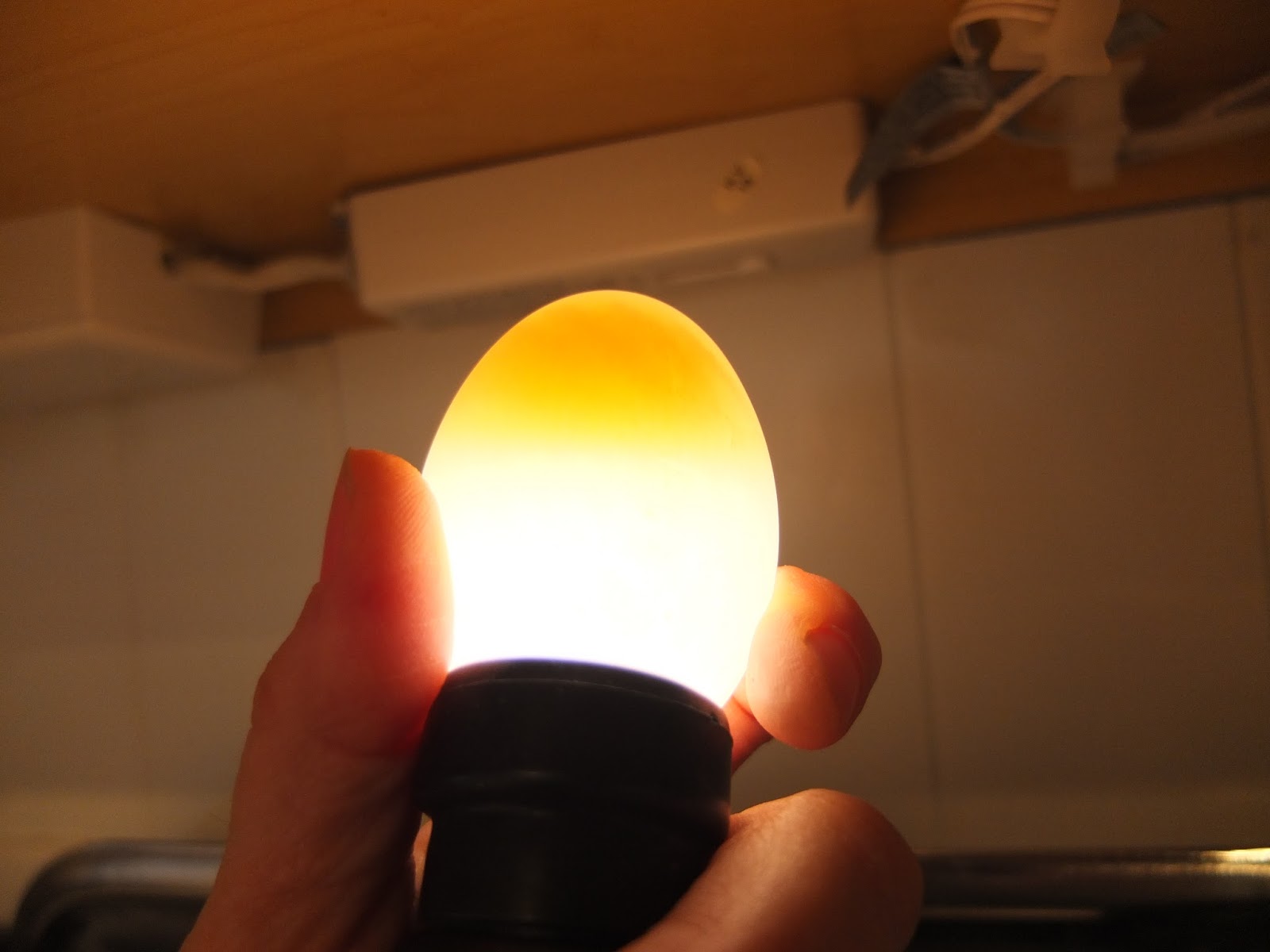
I use a special high powered flashlight with a small collar to 'candle' the eggs. 

The light is so bright that it lets you see what's inside the egg.
I can tell that this egg is good to eat.
There is a dark yellow area at the top,
the bottom of the egg looks clear.

This is a duck egg.
You can see the yolk at the top of the egg.
This one is good to use, too.
If an egg isn't good the yellow yolk is a dark color, and it fills at least half the egg. We bury them in the garden because if you crack them open they usually smell bad. They aren't good to eat, either.

*     *     *     *     *

River is on the left, Misty is on the right.

Serenity.
She has chubby cheeks because she's chewing her cud.
 These three goats are going to have their babies soon. They are due to kid any time after March 30.
We don't know how many babies they will have, and we aren't always sure of the exact date they will have their babies.

You can guess how many kids each goat will have! You can count how many days until March 30 to find out how long it will be before they are ready to kid.

*     *     *     *     *
All of these photos have something that I'm thankful for. Something that makes our life easier on the farm, and in the house. You use it every day, too.

Can you guess what it is?


It's plastic!

Plastic makes our life so much easier on the farm. We have plastic buckets to carry water in, or to hold feed. We have plastic dog houses that are sturdy and keep kid goats safe and warm. There is a plastic coating on electrical wires and extension cords to keep the electricity from hurting people or animals. Baling twine is made from plastic, it hold the bales of hay together so they are easy to store, and to move from the field to the barn. Wood shavings come in plastic bags so we can store them easily before we put them in the stalls for the goats and the cow to sleep on. We use plastic hoses on the milker when we milk Echo. We use rubber hoses on the milker, too. I buy flowers and other plants that are grown in plastic pots. We start our seeds in plastic containers, too. We use plastic barrels to store food in. We use a plastic cover the keep the water and snow off the connection between the heated water bucket and the extension cord.

Look around and see all the wonderful things made out of plastic that you use every day. I am very grateful for plastic!

Do you know when plastic was invented? There are many different types of plastic, but the first plastic was invented by a man named Alexander Parkes in 1862. That's a long time ago! Sometimes an invention takes a long time before it is used in our every day life.

Some people think that plastic is bad, but it has made our life much easier and much nicer. If you are interested in learning more about plastic, when it was invented, what types of plastic there are, and how plastic is used you can use this link.

https://www.thoughtco.com/history-of-plastics-1992322

Have a great week!


Thursday, April 21, 2016

Graphing Eggs

Welcome back!

Thank you so much for bringing me containers for milk! You'll see later why I needed so many. 

This week I'm going to show you my graph. I hope you made a graph, too.


Here is my graph.
Does yours look the same, or different from mine?
I counted the eggs I collected each week, then entered the data into my graph.

Did you notice that there are only three bars on the first week? That's because the little grey chickens hadn't started laying their eggs yet.

There aren't very many duck eggs, or small eggs because we only have one duck, and we only have two small chickens.

Did you notice that week 1 has the fewest eggs? That's because I only counted eggs for 5 days that week, not 7 days.


I thought you might like to see what my tracking paper looks like.
This is how I collected the data and kept track of it each day.
The graph above looks muck nicer!

I collected 564 eggs over 5 weeks.
There are 12 eggs in each dozen.

564 ÷ 12 = 47 dozen eggs


The food we buy for the chickens costs about 20¢ per pound. The chickens and duck ate about 125 lbs of food during the 5 weeks I was counting eggs.
20¢ x 125 = $25

To find out how much each dozen eggs cost I divided $25 by 47 dozen eggs.
$25 ÷ 47 dozen = 53¢ for each dozen eggs.
We didn't add the cost of water, or the cost of heating the water in the winter. Our eggs cost more in the winter because it costs more to keep the water warm. Chickens also eat more in the winter because it's cold. It also takes us time to collect and clean the eggs. And it takes time to feed and water the chickens, and to clean their pen. 

If you buy eggs from the store you have to pay for all of those things, too, not just the chicken feed. You need to pay for the carton, and for a place for the chickens to live. You also have to pay someone to bring the eggs to the store!

In the spring and summer the chickens eat less food because they like to eat bugs and grass in the pasture. We're glad that the chickens eat so many bugs!

Here's a link to last years post on graphing eggs.


I thought you might like to see what we put in our nesting boxes.
Plastic Easter eggs!
The plastic eggs let the chickens know that this is a good place to lay eggs.
We still have to look all over for eggs because chickens like to hide their eggs.
Silly chickens!
*     *     *    *     *     *
Do you see something different about River's front legs?
What's missing?
Her splint! We took it off on Monday and her right front leg is strong and straight!

One other thing that's different in the picture is that River is eating from her mom. Last week I showed you drinking a bottle. Usually when a kid starts with a bottle they won't eat from their mom.

I think River is very smart because she learned how to eat from her mom! We still give her a bottle or two every day to make sure she gets enough to eat, and because it's fun to feed a goat kid with a bottle.


I thought you might like to see what it looks like when a goat kid eats from her mom.

*     *     *    *     *     *

I thought you might like to see what our refrigerator looks like.
Echo gives a lot of milk!
That's why we need so many containers!
Echo fills between 4 and 5 gallon containers every day.
The chickens lay a lot of eggs!

Do you see the yellow stuff at the top of the containers? That's cream! We can shake the container of milk and it mixes in. Yummy, creamy milk!

If we want just cream then we skim it off the top to make butter and ice cream.


This is something I'm very excited about.
It doesn't look like much.
We thought this tree died during the winter.
But it didn't! It's growing a new branch from the trunk.
I think it's because I pour about 5 gallons of water on it every day.
We don't like wasting water so when we're done cleaning the milker
we pour the water on this tree, and the garden.


This tree will grow very tall and provide a lot of shade for the animals. We don't have air conditioning in the barn so we like to make sure they have some place to get out of the sun in the summer time.

If you scroll back up to the tracking page you'll see that I wrote a note on the paper by Mon 28. That's when the turkey hen started sitting on her eggs.

Turkey's usually hatch out their eggs in about 25-28 days. How many days has it been since she started sitting?

I hope you have a great week!


Thursday, April 14, 2016

New Goat Kids!

Welcome back!

Wow! We had an exciting week during Spring Break!

Saturday there were two goat kids born at Welcome Home Farm. One was born early in the morning, one was born very late at night.

Did you know that baby goats are called kids?

I'll take some videos next week of the kids playing.

Here's Quin visiting the two new kids.

It's so much fun to get inside the little dog house with the kids!

The goat kids need to wear sweaters because it's been a little bit chilly. They stay warmer and grow better if they have sweaters on.

Do you see the red light on the left side of the picture? That light comes from a heat lamp. If the kids are cold they can sleep under a warm lamp. They also like to sleep inside the dog house because it's warm inside.

This kid's name is River.
Her mother is Misty.
She is wearing a red sweater to keep warm.
She's also under a heat lamp to stay warm.
River was almost dead when she was born. We don't know what happened, we don't know why. We worked very hard to keep her alive!

She was very cold when she was born a little after midnight. Matt and I took turns using the blow dryer to warm her up. We have to make sure she's warm before she can eat. People can eat if they are cold, but goat kids can't. If we feed them when they are cold they will die because their stomach doesn't work properly if they are cold.

Look at River's front leg near the wall. That's her right leg. Her leg was hurt while she was being born.


The leg in the back of the picture is just right! The hoof is flat on the floor.
The hoof in the front of the picture is bent.
We had to put a splint on it so that it would heal.

We used a tongue depressor for a splint.
Sorry the picture is so bad! I had to take it while I was feeding her.


Do you remember the name of the covering on the hooves of newborn animals with hooves?
It's the eponychium!
Here is a link so you can hear how to say it.
River had quite a bit of it on her hooves. Matt took a picture so you could see it.

River was very weak even after we warmed her up. She tried to stand but couldn't do it. Matt had to feed her with a syringe because she wasn't strong enough to suck on a bottle, or to get milk from her mother, Misty.

She was so weak that she couldn't swallow very much milk, either. We were finally able to put her under the heat lamp at 3:30 in the morning. She was born at 12:15, just after midnight.

Matt had to go out at 4:30 and again at 5:30 to feed her a little bit more, and to make sure she was staying warm.

I went out at 6:30 to feed her and she was finally getting strong enough to drink a little from the bottle. It was a lot of work to keep River alive for the first 24 hours! We had to feed her every hour or two.

Now look at her!
She can drink a bottle full of milk with no problems at all!
We still have to feed her every 3 or 4 hours because we don't want her to get sick.
Next week we'll feed her every 5 or 6 hours because she will be bigger and stronger.


Serenity is the kid in the blue sweater.
Annie is her mother.
Serenity was born early Saturday morning.
She was already drinking milk from her mother when I got out to the barn to milk the Echo, the cow.
*     *     *     *     *

Here's the last two weeks of egg counts.

I'll make my graph this week and show you what it looks like next week. 

  • Friday, April 1 I collected 10 brown eggs, 4 green eggs, 0 duck eggs, 1 little egg, and 1 tiny pullet egg
  • Saturday, April 2 I collected 6 brown eggs, 4 green eggs, and 1 duck egg.
  • Sunday, April 3 I collected 12 brown eggs, 5 green eggs, 1 duck egg, and 2 little eggs
  • Monday, April 4 I collected 8 brown eggs, 6 green eggs, and 1 duck egg
  • Tuesday, April 5 I collected 6 brown eggs, 2 green eggs, and 1 duck egg.
  • Wednesday, April 6 I collected 14 brown eggs, 4 green eggs, 1 duck egg, and 1 little egg.
  • Thursday, April 7 I collected 6 brown eggs, 7 green eggs, 1 duck egg, and 2 little eggs.
  • Friday, April 8 I collected 3 brown eggs, 3 green eggs, and 1 duck egg.
  • Saturday, April 9 I collected 13 brown eggs, 4 green eggs, 1 duck egg, and 1 little egg.
  • Sunday, April 10 I collected 6 brown eggs, 4 green eggs, 1 duck egg, and 2 little eggs.
  • Monday, April 11 I collected 7 brown eggs,  2 green eggs, 1 duck egg, and 2 little eggs.
  • Tuesday, April 12 I collected 6 brown eggs, 4 green eggs, 1 duck egg, and 2 little eggs.
  • Wednesday, April 13 I collected 7 brown eggs, 6 green eggs, 1 duck egg, and 2 little eggs.
  • Thursday, April 14 I collected 20 brown eggs, 14 green eggs, 1 duck egg, and 2 little eggs. (I found where the chickens had been hiding their eggs! In one of the dog houses!)


Next week I'll show you my graph. 
I hope you have a wonderful week!

Friday, March 25, 2016

A New Calf!

Welcome back!

We are so excited to show you our new calf!

This is Stumpy!

He was born Friday, March 22 2016

How old is he today?
Did he come sooner than we expected?
How many days early did he come?

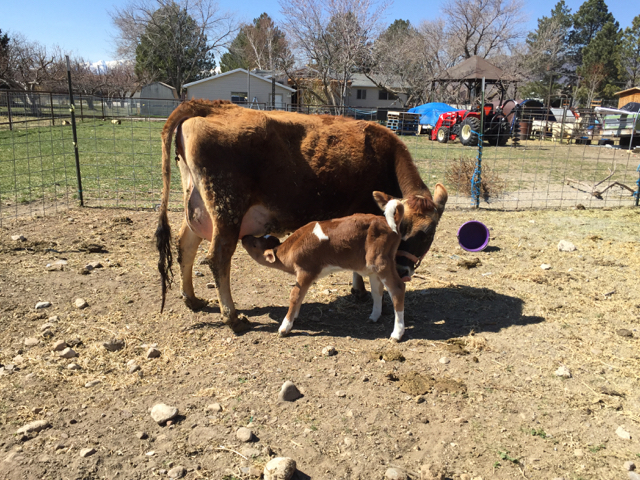
This is how a calf drinks milk from his mother.
Echo is a wonderful mother!
Quin came to see Stumpy on the day he was born.
Quin is 3 years old.

My friend's cow had a calf the next day.
She watched it be born.
This is what a calf looks like right after she's born.

When they are born their hooves are covered with a soft covering called eponychium.

It covers with the hoofs to protect the mother while the calf is being born.
It dries quickly so their hooves get hard and they can stand on them.

This is what the calf looks like all dried off, but only a few hours old.
One of the first things we do after a calf is dried off is to measure them and weigh them. Nurses do the measured you when you were born, too!


We measure a calf's cannon bone.
That's the bone that goes from their ankle to their knee.
When Stumpy was born his was 6.5" long.
On Thursday (in the picture) his cannon bone was 7.5" long.
He grew 1" in a week!

We also weighed him the day he was born. He was 60.3 pounds. Most first graders weighs about 50 pounds. Stumpy weighed more than most of you the day he was born!

We also measure the height of his pin bone. He was 27.5" tall at his pin bone. Most 6 year olds are 42" tall, so you are taller than Stumpy.

A cow's pin bone is the top part of the hip on her back leg.

Echo measures 48" at her pin bone.
Would your head be taller than Echo's pin bone measurement?

I'll have more measurements and counting for you next week!

*     *     *     *     *     *

Here are the egg counts for this week:


  • On Friday I collected 5 brown eggs, 2 green eggs, and 1 duck egg.
  • On Saturday I collected 6 brown eggs, 2 green eggs, and 0 duck eggs.
  • On Sunday I collected 14 brown eggs, 8 green eggs, and 1 duck egg.
  • On Monday I collected 7 brown eggs, 7 green eggs, and 1 duck egg.
  • On Tuesday I collected 17 brown eggs, 11 green eggs, 0 duck eggs, and 1 little egg.
  • On Wednesday I collected 8 brown eggs, 3 green eggs, 0 duck eggs, and 1 little egg.
  • On Thursday I collected 10 brown eggs, 5 green eggs, 0 duck eggs, and 2 little eggs.
We have two small, gray chickens. They lay small eggs. They started laying this week! 
Do you remember this friendly chicken who comes to say hi to me each morning?
She lays little eggs!

Next week I'll post more pictures about how we measure cows and goats. I'll also post more pictures of Stumpy and Echo. We're getting milk from Echo so in the next few weeks I'll show you how we milk her.


I hope you have a wonderful week!