Enjoy the tid-bits of our everyday life: dairy goats, sheep, poultry, beekeeping, gardening, cheese making, spinning and knitting, quilting, and soap making. We're not experts, but we are willing to give almost anything a try! We're learning something new everyday--drop by once in a while and see what we've learned today!
Thursday, August 28, 2014
Saturday, May 3, 2014
New Chicks 2014
We got chicks again this year. The older hens are 3 or more years old. They didn't lay through the winter so we got rid of most of them. A few were processed and many went to a woman who brings them to ranchers in the spring. Apparently there are ranchers and hobby farms that want older hens and ducks in their pastures to eat the bugs. They don't want to feed them much, they don't want to pay much for them, and they don't care if they get eggs.
We got new chicks on February 21. I wanted some cochins because they are so gentle and easy-going. They aren't great layers, but I'm not interested in having White Leghorns unless someone gives them to us. They are too excitable!
Our little flock includes 4 Buff Cochins, 4 Plymouth Rocks (or Barred Rocks), 4 Amerucaunas, and 3 Blue Silkies. There were 4 Silkies, but one died.
We've still got our Roo that's a mix of Arucana and I don't know what else, and 4 older hens that started laying now that spring is here. One is an Arucana so we get blue eggs, one is a mixed Arucana and she lays an olive colored egg, one Buff Orpington, and one Rhode Island Red.
When they all start laying this fall we will have enough eggs to feed our little family, plus Blondie and her husband; and Spunky, her husband, and their son.
I turned into an 'egg snob' after having chickens. I have a hard time eating store bought eggs now. The fresh ones that have been raised on pasture taste so much better!
Just a side note on what free-range means:
In the United States, USDA free range regulations currently apply only to poultry and indicate that the animal has been allowed access to the outside. The USDA regulations do not specify the quality or size of the outside range nor the duration of time an animal must have access to the outside.
The term "free range" is mainly used as a marketing term rather than a husbandry term, meaning something on the order of, "low stocking density," "pasture-raised," "grass-fed," "old-fashioned," "humanely raised," etc.
There have been proposals to regulate by the USDA the labeling of products as free range within the United States. As of now what constitutes raising an animal free range is entirely decided by the producer of that product. (Wikipedia)
When you buy 'free-range' chicken eggs in the store, you may not be getting what you think you are getting.
We got new chicks on February 21. I wanted some cochins because they are so gentle and easy-going. They aren't great layers, but I'm not interested in having White Leghorns unless someone gives them to us. They are too excitable!
Our little flock includes 4 Buff Cochins, 4 Plymouth Rocks (or Barred Rocks), 4 Amerucaunas, and 3 Blue Silkies. There were 4 Silkies, but one died.
We've still got our Roo that's a mix of Arucana and I don't know what else, and 4 older hens that started laying now that spring is here. One is an Arucana so we get blue eggs, one is a mixed Arucana and she lays an olive colored egg, one Buff Orpington, and one Rhode Island Red.
![]() |
| Our Buff Cochins. Vet2Be said he likes this bird because they are so calm and easy to catch and put into the coop. We usually find them under the coop at bed-time instead of inside the coop. |
![]() |
| One of the Barred Rocks. She's a pretty bird! |
I turned into an 'egg snob' after having chickens. I have a hard time eating store bought eggs now. The fresh ones that have been raised on pasture taste so much better!
Just a side note on what free-range means:
In the United States, USDA free range regulations currently apply only to poultry and indicate that the animal has been allowed access to the outside. The USDA regulations do not specify the quality or size of the outside range nor the duration of time an animal must have access to the outside.
The term "free range" is mainly used as a marketing term rather than a husbandry term, meaning something on the order of, "low stocking density," "pasture-raised," "grass-fed," "old-fashioned," "humanely raised," etc.
There have been proposals to regulate by the USDA the labeling of products as free range within the United States. As of now what constitutes raising an animal free range is entirely decided by the producer of that product. (Wikipedia)
When you buy 'free-range' chicken eggs in the store, you may not be getting what you think you are getting.
Thursday, May 1, 2014
Kidding 2014
We only bred two goats out of four this year, Annie and Sandy.
Clover is at least 12, so we didn't want to chance loosing her. It would be hard on her to have kids this late in life.
Misty was so sick from mastitis last year that we wanted to give her a year break before we bred her again. We'll breed her this fall. She only has half an udder, so she only gives about 3 lbs (1 1/2 quarts) of milk each day.
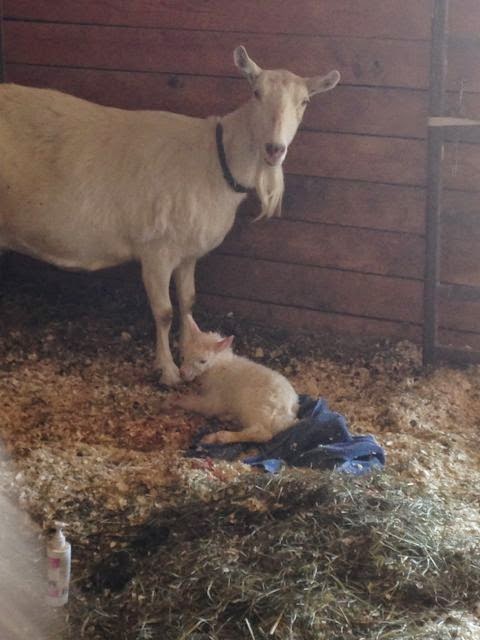
Annie kidded on April 8 this year. She had a beautiful buckling that is healthy and strong. She also had a still-born doeling. We have no idea what happened. There was no decay, so it hadn't been dead long.
Annie is giving almost a gallon a day. She's healthy and strong and doing well, as always. She's been one of our most reliable goats.
Sandy should kid out the end of May. We're not sure exactly what date she was bred, so we're just guessing by how she looks. Not very good animal husbandry on our part, but sometimes other things get in the way of writing things down when we should.
If you have any name suggestions for the buckling, please leave it in the comments section!
Clover is at least 12, so we didn't want to chance loosing her. It would be hard on her to have kids this late in life.
Misty was so sick from mastitis last year that we wanted to give her a year break before we bred her again. We'll breed her this fall. She only has half an udder, so she only gives about 3 lbs (1 1/2 quarts) of milk each day.
Annie kidded on April 8 this year. She had a beautiful buckling that is healthy and strong. She also had a still-born doeling. We have no idea what happened. There was no decay, so it hadn't been dead long.
![]() |
| He was disbudded on April 14th so he's not as cute now as he was right after he was born. |
Sandy should kid out the end of May. We're not sure exactly what date she was bred, so we're just guessing by how she looks. Not very good animal husbandry on our part, but sometimes other things get in the way of writing things down when we should.
If you have any name suggestions for the buckling, please leave it in the comments section!
Tuesday, April 29, 2014
Bees 2014
We lost our bees in late February or early March. Our fault, we didn't realize we needed to feed them this year.
He installed a new hive and Queen on Saturday (4/26). It was cold and rainy so we are hoping all goes well with them.
Hubby is planning on feeding the new hive starting in October or November to make sure they can make it through the winter.
He installed a new hive and Queen on Saturday (4/26). It was cold and rainy so we are hoping all goes well with them.
Hubby is planning on feeding the new hive starting in October or November to make sure they can make it through the winter.
![]() |
| You can see the feeder on the front. It was cold when I took the photo so all the bees are inside the hive staying warm, I hope! |
Sunday, April 27, 2014
Cleaning Stalls and Other Spring Things
Friday we cleaned one stall. Since we've reduced the herd by almost half we could leave the stall empty and let it dry out for a day, but with all the rain I doubt we will be able to. We'll probably have to let the buck and the steer in for the night.
We picked up and packed away the feed empty bags that were taking over the barn. They are great for when we are weeding and need to send the noxious weeds to the dump. They hold a lot and are much sturdier than the lawn and leaf bags we can buy at the store. Plus, these are free.... sort of. We had to pay for the feed, but we consider it recycling. The best kind of recycling because it doesn't use any resources to break down a finished product to turn it into something new.
![]() |
| Here's the little lamb we brought home from Lamb and Wool Festival on April 12th. He was about 3 weeks old in this picture. |
Thursday, April 24, 2014
Spring Gardening
Spunky and I were out in the garden today. We planted seeds in the house in February and March, which turned out to be too early.
She said it would be a good idea to keep a garden journal, so I'm back to posting!
The weather was nice. It was clear and cool, but not cold.
Here are some of the weeds that are growing well right now. I didn't see any puncture weeds, but they often don't start for another few weeks.
You can find a good link to common weeds at the USU Extension site. There are two PDF booklets to download. We usually take care of the weeds the way the extension service recommends. Sometimes we use 2,4 D, most often we dig them out roots and all.
My favorite hoe in the garden is the Winged Weeder. It's sharp on both edges and cuts through weeds in either direction.
We tried vinegar as a weed killer one year. Although it knocked the green leaves out for a while, it didn't kill the roots. In fact, since our soil is so alkaline it seemed that the vinegar was a good fertilizer!
She said it would be a good idea to keep a garden journal, so I'm back to posting!
The weather was nice. It was clear and cool, but not cold.
Here are some of the weeds that are growing well right now. I didn't see any puncture weeds, but they often don't start for another few weeks.
![]() |
| Redstem filaree grows on the access road all the time. Lovely little purple flowers! But it is invasive! |
![]() |
| We're pretty sure this is Quackgrass. The animals will eat it, but it's invasive and hard to get rid of in the garden |
![]() |
| Mallow weed. It grows everywhere! Not really harmful to the animals, but they won't eat it if it gets too big. |
![]() |
| Bur buttercup, bad for the animals because they have spiny burs. This also grows in our sandbox, and we can't get it out of there fast enough! We don't want little kids getting burs in their hands, feet, or knees when they are trying to play. |
![]() | |
| Foxtail, this is one of the weeds that is 'dangerous' on the farm. It get stuck in animals throats when they eat it, it works it's way into paws and ears on the dogs, it spreads like wildfire! |
![]() |
| Broadleaf Plantain. This one isn't too bad, but it does take over the garden if we let it. I'm not too fussy about the lawn, but it also tends to take over the lawn. |
![]() |
| Shepherd's Purse. It multiplies by seed.... and one plant can produce between 500 and 90,000 seeds. It's everywhere! |
You can find a good link to common weeds at the USU Extension site. There are two PDF booklets to download. We usually take care of the weeds the way the extension service recommends. Sometimes we use 2,4 D, most often we dig them out roots and all.
My favorite hoe in the garden is the Winged Weeder. It's sharp on both edges and cuts through weeds in either direction.
We tried vinegar as a weed killer one year. Although it knocked the green leaves out for a while, it didn't kill the roots. In fact, since our soil is so alkaline it seemed that the vinegar was a good fertilizer!
![]() |
| Our lambs ear looks great! The bees love it, so it's planted in the garden not very far from the hives. |
![]() |
| The lavender looks dead in the photo, but it's starting to sprout. The bees also love lavender, which is why it's also planted in the garden near the hive. |
![]() |
| Egyptian Walking Onions. This is their third year and I'm sure we will be able to harvest and use them this year! |
![]() |
| New royalty purple raspberries. We bought some berries last year and thought they were wonderful so we decided to try to grow some this year. |
Tuesday, January 21, 2014
4Ever Recap Lid Recall
There is currently a voluntary recall on 4Ever lids. Since most people don't 'register' their lids or sign up to get emails from companies like this, I thought it would be a good idea to spread the information as well as I could.
Attention valued customers: Please note that there is currently a voluntary recall on red silicon seals due to a higher than anticipated rate of seal failure while in storage when used in pressure canning and water bath canning.
If you have used these seals for pressure canning or water bath canning, please check all jars. Silicon seals are being replaced by nitrile seals at the customer's request. For more information, please email us at 4wardindustries@gmail.com .
Note: The silicon seals are fine to use with lacto-fermentation, storage of dried goods and freezer "canning." We apologize for any inconvenience and appreciate your cooperation and understanding.
I don't use the resealable lids but I know others do. If you used some (especially the 4Ever brand), please go check your seals. People that I know of are experiencing a 40% - 60% failure rate. It takes a few months for the seals to break, so now is a good time to check.
You can find the information here:
http://www.4everrecap.com/
Subscribe to:
Posts (Atom)